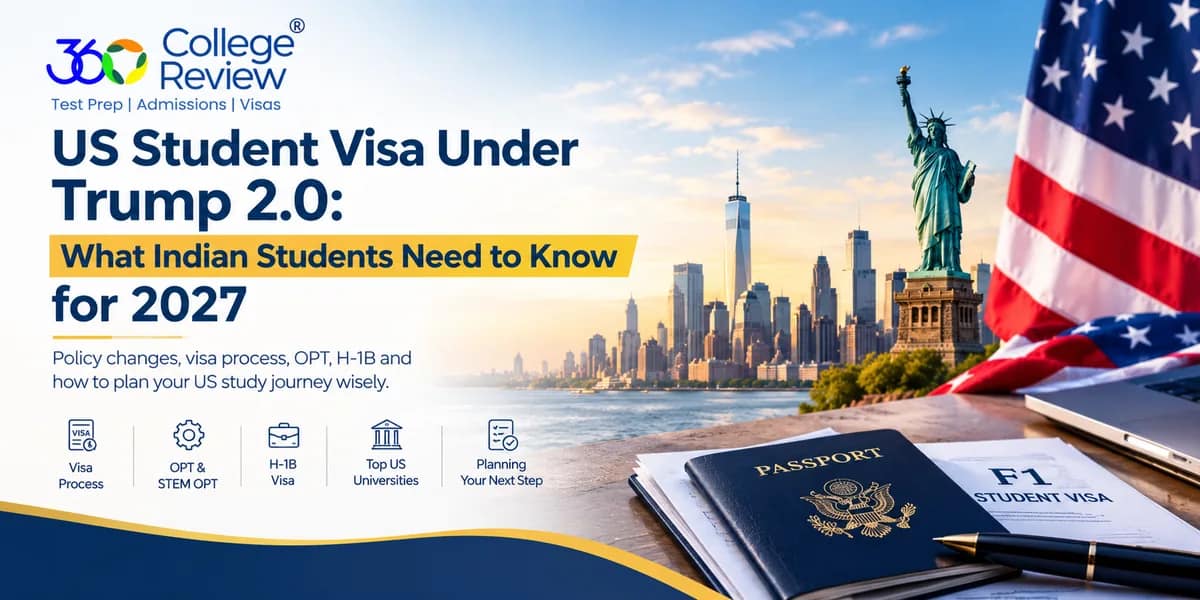
If you’re an Indian student preparing to study in the US, you’re undoubtedly torn between relief and apprehension as Trump takes over once again. The situation of Indian students in the US remains uncertain, despite the US being the preferred study destination for 1.17 million international students as of 2023.
Despite the tense immigration climate, US universities are still vying for Indian students. So how do you prepare yourself as an Indian student to make the most of your chances in 2026–2027?
The F-1 student visa is not closed for good, but the processing time for US student visa interviews in India has increased, and social media screening has intensified. The new administration has taken up social media screening of visa candidates more seriously, so be extra careful with what you write or share on your social media accounts. Any potentially controversial posts that could be interpreted as anti-American or extremist might see your visa application denied.
The wait time for F-1 visa interviews at Indian consular posts continues to be long, and administrative processing (AP) is more common than before. The administrative processing time for F-1 student visas used to be around 2–3 months. However, it could balloon to 6–12 months in the Trump era. With the rise of AP, many Indian students are now choosing to apply for the F-1 visa in their second year of study. Students studying STEM subjects that fall under the Technology Alert List (TAL) could see processing times for their visa application delayed by 60–120 days.
To summarize, the F-1 process is as follows:
There is no doubt that the main change affecting Indian students in the Trump era is Step 6. The requirement of showing non-immigrant intent is now open to more interpretation, and the visa officer now has more questions and documentation to evaluate your intent.
Optional Practical Training (OPT) is the most common way for F-1 students to gain work experience in the US. OPT is valid for 12 months for all fields of study and can be extended by 24 months for STEM students. In the 2021–2022 academic year, there were 68,188 Indian OPT students in the US, the highest number since records began.
| Metric | India | China |
|---|---|---|
| OPT approvals (2004–2016) | 441,400 | 313,500 |
| STEM OPT workers (2019) | 78,000 | 30,000 |
While there is nothing stopping an F-1 student from working in the US on OPT, the Trump administration has threatened to impose restrictions on the OPT program. If you are an Indian student thinking of doing OPT after graduation, please make sure that you have a Plan B.
Most Indian students who want to settle in the US eventually apply for an H-1B visa after exhausting OPT. The H-1B visa allows skilled workers to stay in the US on a temporary work visa. The demand for H-1B visas significantly outweighs the supply, and there is no guaranteed way to get one.
Employers file petitions with USCIS on a yearly basis to reserve a spot for a foreign worker, and these are chosen randomly through a lottery system. There are caps on the number of H-1B visas issued: 65,000 for people with a bachelor’s degree, while 20,000 are reserved for people with a master’s degree or higher. The selection rate rarely goes above 35%, so most students who apply for an H-1B visa find themselves unable to proceed further with their application.
American universities remain at the forefront of the world’s research and innovation, so studying in the US continues to be the best choice for Indian students who want to specialize in STEM or business. However, the most important thing for an Indian student to focus on is choosing the right university based on their financial capabilities and field of study.
The best universities in the US include the Ivy Leagues and other private research institutions like Harvard, MIT, Stanford, Caltech, Columbia, Princeton, Yale, UPenn, and Cornell. These universities have deep pockets and can support your education financially. Furthermore, these universities usually have better legal support for international students than public universities.
Other excellent options for Indian students on a budget are the public universities with large international student cohorts, like the University of Michigan, UC Berkeley, UCLA, Georgia Tech, UIUC, Purdue, UT Austin, and University of Wisconsin–Madison.
1. Apply as early as possible. Most universities have rolling admissions, which means there is no hard and fast date for applying to a US university. However, it is best to apply early so that you can get your I-20 in time and schedule your visa interview beforehand.
2. Clean up your social media activity. Social media screening of visa applicants has become more rigorous in recent years, so it is best to avoid any potentially controversial posts. It might seem like an overreaction, but there have been cases of student visa applicants getting rejected simply because of what they posted on social media.
3. Prove that you have non-immigrant intent. When asked during your visa interview whether you have any intention of staying in the US permanently, it is best to provide concrete reasons as to why you want to return to your home country after your studies. Having property, family, or a job in your home country is a good sign in this regard. Avoid saying or implying that you want to settle in the US, as the F-1 visa is only meant for temporary stays.
4. Budget for your education in the US. Education in the US can be quite expensive, especially at a private university. You should also budget for other expenses like travel, accommodation, food, and healthcare. You must show proof of funds for at least one year of study, and it is better to have more than the required amount.
| Expense | Annual Cost (USD) |
|---|---|
| Tuition — public university | USD 25,000–60,000 |
| Tuition — private university | USD 40,000–80,000 |
| Living expenses | USD 15,000–25,000 |
Fortunately for Indian students, many education loans are available from lenders like HDFC Credila, Avanse, and InCred.
5. Have a Plan B. If things do not work out for you, and you are unable to get into a US university or get denied a visa, it is best to have a Plan B. The best alternatives to studying in the US are Canada, Germany, Ireland, and the UAE.
| Low Risk | High Risk |
|---|---|
| Getting into a US university | Getting denied a visa |
| Getting OPT approved | Getting H-1B approved |
| Finishing your degree | Settling down in the US |
The US remains one of the best options for Indian students, but it is no longer a done deal like it used to be. The biggest change that Indian students have to be wary of is the stricter screening process for F-1 student visas. Fortunately for Indian students, the education quality at US universities continues to be unparalleled.
As mentioned before, the best value for money at the best educational quality is found in public universities with a large international student cohort. Indian students must also keep in mind that the H-1B visa has a low approval rate, and it is better to have a Plan B if you are seriously considering a career in the US after your degree.
If you are thinking of going to the US for higher education, it is best to apply early and be extra careful with your visa interview. Remember that your visa interview is a test of your commitment to returning to your home country after your studies in the US are complete.
And if the political climate in the US becomes too unpredictable, why not consider Canada, Germany, Ireland, or the UAE as alternatives?
– The Author is Mr. Ajay Thiara, Founder & Managing Director of 360 College Review