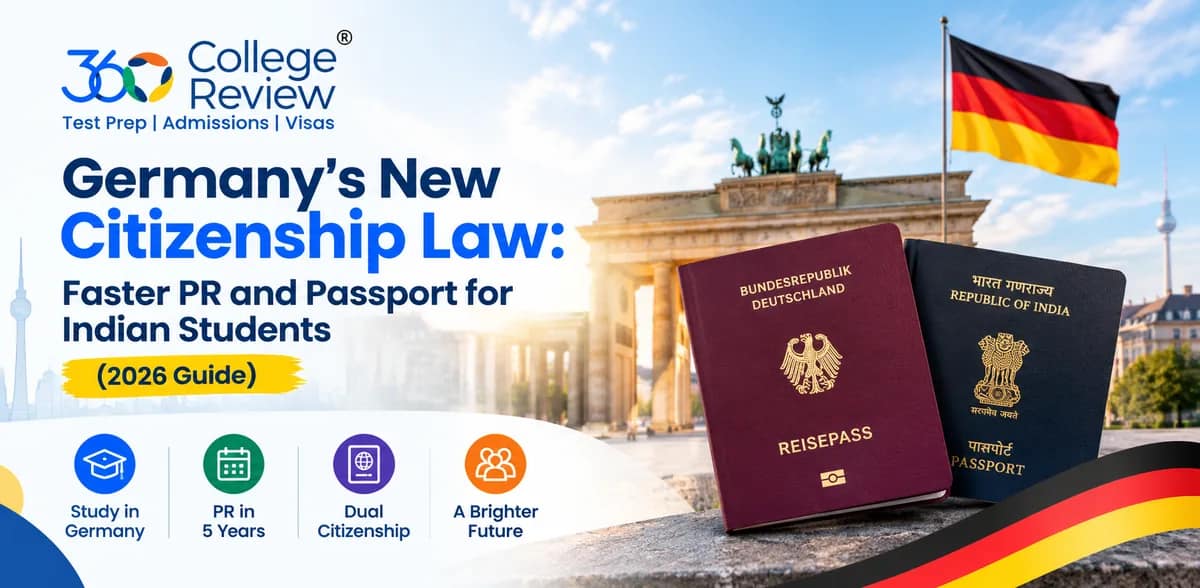
Germany just made it dramatically easier for Indian students to become German citizens. If you’re planning to study in Germany — or you’re already there — this changes the math entirely. We’re talking about a path from student visa to German passport in as little as 5 years, with dual citizenship now legally permitted.
This is one of the most significant immigration policy changes in Europe in decades. And for Indian students, it couldn’t have come at a better time.
The German government passed sweeping reforms to its nationality law that took effect in 2024. The changes are designed to address Germany’s demographic challenges — an aging population, labour shortages, and the need to attract and retain skilled immigrants. For Indian students, the reforms are genuinely transformative.
Previously, you needed to live in Germany for 8 years before applying for citizenship. Under the new law, the standard requirement is 5 years of legal residence.
Your years as a student count toward this. So if you do a 2-year master’s in Germany, you only need 3 more years of employment after graduation to qualify for citizenship. That’s a game-changer.
Here’s where it gets even better. If you demonstrate “exceptional integration”, you can apply for citizenship in just 3 years. To qualify for the fast track, you need:
For an Indian student who arrives in Germany, learns German to C1 level, performs well academically, and integrates actively — German citizenship in 3 years is real.
This is the change that matters most to Indian students. Previously, Germany generally required you to give up your Indian citizenship to become German. For most Indians, that was a non-starter.
Under the new law, dual citizenship is permitted. You can hold both an Indian passport and a German passport. (Note: India does not officially allow dual citizenship — it offers OCI (Overseas Citizen of India) status instead. You’ll need to surrender your Indian passport and take OCI, which gives you nearly all the rights of Indian citizenship except voting and certain property rights. This is a personal decision — understand the trade-offs before proceeding.)
If you’re studying or working in Germany and have a child born there, your child is now eligible for automatic German citizenship if at least one parent has lived in Germany for 5+ years with a valid residence permit. Previously, this required 8 years.
The standard naturalization language requirement is B1 German — intermediate level. This is achievable with 6–12 months of dedicated study. The fast-track (3-year) option requires C1 — advanced level, which takes longer but is doable during a multi-year degree program.
A German passport doesn’t just give you Germany. It gives you EU citizenship — the right to live, work, and study in any of the 27 EU member states plus Switzerland, Norway, Iceland, and Liechtenstein. That’s freedom of movement across most of Europe.
The German passport is consistently ranked among the top 3 most powerful passports in the world — visa-free or visa-on-arrival access to 190+ countries.
German citizenship removes all work permit friction. You don’t need employer sponsorship, Blue Card renewals, or visa anxiety. You can switch jobs freely, start a business, work freelance, or take government positions. For Indian professionals in engineering, tech, pharma, and finance, this is enormous.
Once you’re a German citizen, your spouse and children can also apply for naturalization on an accelerated timeline. If your children are born in Germany after you’ve been a resident for 5+ years, they get automatic citizenship.
The OCI trade-off: India doesn’t allow true dual citizenship. If you naturalize as German, you’ll need to surrender your Indian passport and take OCI status. OCI gives you the right to live, work, and own property in India — but you can’t vote in Indian elections or hold certain government positions. For many Indians, this is an acceptable trade-off. For some, it’s not. Think carefully.
B1 German is mandatory. You can’t naturalize without it. If you arrive in Germany planning to stay in the English bubble — working in English, socializing in English — you won’t reach B1. You need to actively study German from day one.
The citizenship test is real. 33 questions covering German history, law, and society. It’s not extremely difficult, but it requires preparation. Sample tests are available online — practice before applying.
Processing times can be long. Naturalization applications can take 6–12 months to process. Plan ahead. Don’t assume you’ll get citizenship the day you become eligible.
Not all residence years are equal. Your student years count, but the clock starts from when you register your residence in Germany (Anmeldung). Make sure your registration is done correctly from day one.
| Factor | Germany (Post-Reform) | Canada | Australia | UAE |
|---|---|---|---|---|
| Citizenship timeline | 5 years (3 fast track) | 3–5 years | 4–5 years | No direct path |
| Dual citizenship | ✅ Yes | ✅ Yes | ✅ Yes | ❌ No |
| Tuition cost | Free–low | Moderate-high | High | Moderate |
| Language requirement | B1 German (C1 for fast track) | English/French | English | English/Arabic |
| EU passport access | ✅ 27 countries | ❌ | ❌ | ❌ |
| PR timeline | 21–33 months on Blue Card | Varies, harder now | 4–5 years | Complex |
The verdict: Germany now offers the most attractive citizenship pathway for Indian students in Europe — possibly in the world. Free tuition, a clear 5-year path to one of the world’s most powerful passports, dual citizenship, and access to the entire EU job market. The main investment is language learning.
Germany’s citizenship reform is the most underreported story in study-abroad circles. While everyone’s been focused on Canada’s permit caps and Australia‘s financial requirement hikes, Germany quietly made itself the most attractive long-term destination for Indian students who want to build a life abroad.
The path is clear: study in Germany (free or low-cost), learn German to B1, get a job on a Blue Card, apply for PR, and naturalize in 5 years. You walk away with an EU passport, dual citizenship rights, and a world-class education that cost you a fraction of what the US or Australia would charge.
If you’re strategic about your study-abroad journey — thinking beyond just the degree to what comes after — Germany just became the smartest choice in 2026.
– The Author is Mr. Ajay Thiara, Founder & Managing Director of 360 College Review