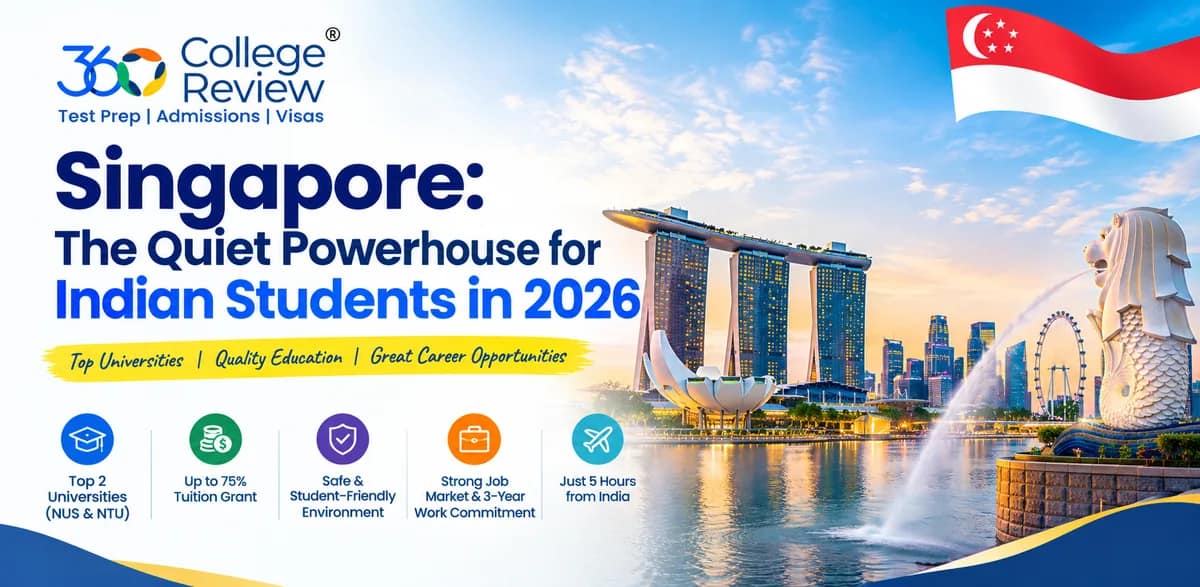
When you think about studying abroad, Singapore doesn’t always come to mind first. The US, UK, Canada, Australia — those are the usual suspects. But here’s what most Indian students (and parents) are missing: Singapore is quietly becoming one of the smartest study-abroad choices available in 2026.
Two of Asia’s best universities. English-medium education. One of the safest countries in the world. A 5-hour flight from India. A booming tech and finance job market. And a tuition grant that covers up to 75% of your fees in exchange for a 3-year work commitment after graduation.
Let’s break down why Singapore deserves a serious spot on your shortlist.
Singapore isn’t trying to compete with the US or UK on volume. It competes on quality, outcomes, and strategic positioning. The country has deliberately built a compact, elite higher education system — fewer universities, but each one punches well above its weight globally.
This is a country that takes education seriously at every level — and it shows in the university experience.
NUS is consistently ranked among the top 10–20 universities globally (QS and THE rankings). It’s the flagship university of Singapore and one of the most respected institutions in Asia.
Strengths:
Indian student presence: NUS has a growing Indian student community, particularly in engineering, computer science, and MBA programs. The university actively recruits from India through dedicated admission events.
NTU is another globally top-ranked university — frequently in the top 20–30 worldwide. It’s particularly renowned for engineering, materials science, and sustainability.
Strengths:
Indian student presence: NTU has a strong Indian student community in engineering and science programs, with active cultural associations and support networks.
This is the part that most Indian families don’t know about — and it changes the financial math entirely.
The Singapore Ministry of Education (MOE) offers a Tuition Grant scheme for international students enrolled at Singapore’s autonomous universities (NUS, NTU, SMU, SUTD, etc.).
How it works:
Example cost breakdown (with MOE grant):
| Program | Full Tuition (Annual) | With MOE Grant | Your Cost |
|---|---|---|---|
| Engineering (NUS/NTU) | S$38,200 | ~S$17,800 | ₹11 lakhs |
| Computer Science | S$38,200 | ~S$17,800 | ₹11 lakhs |
| Business | S$38,200 | ~S$17,800 | ₹11 lakhs |
| Medicine | S$74,500 | ~S$34,200 | ₹21 lakhs |
Without the grant, Singapore is expensive. With the grant, it’s competitive with or cheaper than Canada and Australia — and you’re getting a globally top-20 education.
The 3-year work bond is a feature, not a bug. It guarantees you post-graduation employment in one of the world’s strongest economies. Most graduates consider it a benefit — you get 3 years of guaranteed work experience in Singapore, which is a global hub for tech, finance, and logistics.
Singapore is a 5-hour flight from Mumbai, Delhi, and Chennai. Time zone difference is just 2.5 hours from IST. You can video-call your family at normal hours. You can fly home for festivals. Parents can visit easily. This matters more than students often realize — especially for first-time travelers.
English has been the primary language of instruction in Singapore since 1987. All university programs are taught in English. Business, government, and daily life operate in English. You do not need to learn another language to study, work, or live in Singapore. (That said, Singapore has four official languages — English, Mandarin, Malay, and Tamil — and knowing some Mandarin can improve your job prospects.)
Singapore is consistently ranked among the top 3 safest countries in the world. Violent crime is extremely rare. Public transport is safe at any hour. For Indian parents worried about sending their child abroad, Singapore is the easiest “yes” they’ll ever give.
Singapore is the Asian headquarters for Google, Meta, Amazon, Microsoft, Apple, LinkedIn, Stripe, Twitter/X, and hundreds of other global tech companies. In finance, it’s home to DBS, UBS, Citibank, Standard Chartered, JPMorgan, and Goldman Sachs regional operations. In pharma and biotech, GSK, Pfizer, Novartis, and Roche all have major Singapore operations.
For graduates in computer science, engineering, data analytics, finance, and business, the job market is genuinely strong. Starting salaries for NUS/NTU graduates typically range from S$3,500–5,500 per month (₹2.2–3.5 lakhs), with tech and finance roles at the higher end.
Singapore’s Permanent Residency (PR) pathway for graduates is accessible — particularly under the Tech.Pass and ONE Pass programs for high earners. While PR isn’t guaranteed, graduates from NUS/NTU who work in Singapore for 3+ years and meet salary criteria have a strong case. The process is transparent and points-based.
Singapore Management University (SMU): Specialized in business, economics, law, and information systems. Globally respected for accounting and finance. Located in the city center.
Singapore University of Technology and Design (SUTD): Focused on engineering, design, and architecture. Collaborates with MIT. Small, elite, project-based learning.
Singapore Institute of Technology (SIT): Applied learning focused. Strong industry partnerships. Good for students seeking practical, career-oriented degrees.
ESSEC Business School (Singapore campus): Top-ranked French business school’s Asian campus. Strong MBA and executive education programs.
Cost of living is high. Singapore is one of the most expensive cities in the world. Rent for a room in a shared apartment: S$800–1,500/month. Food at hawker centers: S$4–8/meal. Total monthly living expenses: S$1,500–2,500 (₹90,000–1.5 lakhs). Budget carefully.
The MOE grant requires commitment. The 3-year work bond is a legal commitment. If you break it, you face significant financial penalties. Make sure you’re genuinely interested in working in Singapore post-graduation before accepting the grant.
Admission is extremely competitive. NUS and NTU are among the most selective universities in the world. For Indian students, you need exceptional academic credentials — typically 90%+ in Class 12 boards (or equivalent), strong SAT/ACT scores (if applicable), and compelling extracurriculars. Acceptance rates for international students are often below 10%.
It’s a small country. Singapore is a city-state. The cultural and recreational scene is vibrant but compact. If you’re looking for the sprawling campus life and cultural diversity of a US or UK university, Singapore is different. Some students love the focus and efficiency; others find it constraining.
Climate is tropical. Singapore is hot and humid year-round (25–35°C, 70–90% humidity). If you’re from northern India, this is an adjustment. Air conditioning is everywhere, but outdoor activities during midday are uncomfortable.
Singapore is the study-abroad destination that most Indian students overlook — and that’s a mistake. Where else can you get a top-20 global education, pay 75% less tuition through a government grant, work in one of the world’s strongest economies for 3 guaranteed years, and be a 5-hour flight from home — all in English?
The catch: admission is fiercely competitive, and living costs are high. But if you have the academic profile for NUS or NTU, Singapore offers a value proposition that’s hard to beat anywhere in the world.
For STEM and business students especially, Singapore should be on your shortlist alongside the US, UK, and Germany. It might just be the smartest choice you haven’t seriously considered.
– The Author is Mr. Ajay Thiara, Founder & Managing Director of 360 College Review