India’s top education counselors and immigration experts are reeling in the aftermath of an earth-shattering development – a 35% reduction in study permits issued to international students in Canada. As anxious Indian students, looking to pursue their dreams in the ‘big country up north’, scramble to understand the new norms, it’s important to note that the changes proposed by the Immigration, Refugees and Citizenship Canada (IRCC) have a direct bearing on them as the largest pool of international students in the country.
Let’s dissect the changes to understand exactly what they mean for you:
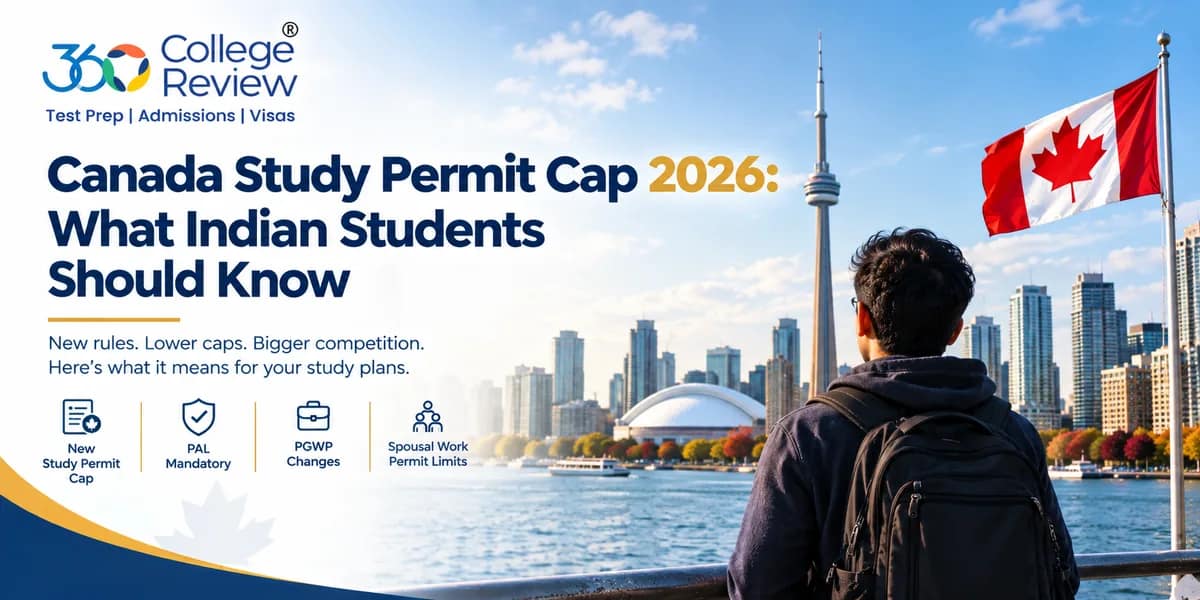
Starting from early 2024, a Provincial Attestation Letter (PAL) from the relevant province is mandatory for a study permit application to be approved. This means that unless your application has a PAL, it will be rejected immediately.
Not all programs now qualify for a Post-Graduation Work Permit (PGWP). Eligibility criteria has been tweaked to only allow programs in occupations that are in demand in Canada.
Spouses of international students can only get an open work permit if the student is enrolled in a master’s, doctorate or a select list of professional programs. This excludes bachelor’s and college diploma programs.
These changes and several others will affect your 2026 study permit application (if you are applying from Fall 2026 onwards) and we take a look at how you can navigate the new system effectively.
First, here are the highlights of the changes that have been announced by the IRCC:
The change in the number of international students that can be admitted to Canadian universities/colleges is perhaps the single most worrying aspect of the new system. While the overall cap has been reduced by 35% (from ~600,000 to ~427,000 for 2025), provinces, especially the ones favoured by Indian students (Ontario, BC, Alberta) have witnessed the biggest reductions.
Starting from early 2024, a Provincial Attestation Letter (PAL) from the relevant province is mandatory for a study permit application to be approved. This means that unless your application has a PAL, it will be rejected immediately.
Not all programs now qualify for a Post-Graduation Work Permit (PGWP). Eligibility criteria has been tweaked to only allow programs in occupations that are in demand in Canada.
Spouses of international students can only get an open work permit if the student is enrolled in a master’s, doctorate or a select list of professional programs. This excludes bachelor’s and college diploma programs.
Now, let’s understand what this means for you:
If you are applying for Fall 2026 and onwards, here are some things that you should know:
When it comes to the new system, your program choice is going to be absolutely critical. A random one-year certificate course at a private college in Toronto might not be PGWP-eligible anymore. You need to pick a program in an occupation that is in demand in Canada (medical, engineering, skilled trades, education, farming, etc)
Your best bet in this new system is to apply to the best universities possible. To do that, you need a Provincial Attestation Letter (remember, this is mandatory for your application to be approved). While your university will apply for the PAL on your behalf (once you have accepted the offer), it’s essential to remember that provinces allocate quotas to universities and these fill up really fast. The earlier you accept your offer, the better.
The proof of funds required has increased significantly with the new system. From January 2024, the cost of living requirement has gone up to $20,635 CAD (for a single applicant) — up from the old $10,000 (this is an additional requirement on top of tuition fees and airfare).
If you are considering a spousal application for an open work permit, it is only viable if you are in a master’s, doctoral or a select list of professional programs.
It is natural to wonder which programs will still be viable in this new system.
Here are the best options available to you:
While the changes announced by the IRCC might seem pretty restrictive at first glance, there are still several ways in which you can increase your chances of getting a study permit approval in 2026:
If you apply early, you have a higher chance of getting a Provincial Attestation Letter (PAL). Applications for Fall 2026 open in October 2025 and the early applicants will get PALs, while the late ones will be placed in a waitlist.
Instead of applying to universities only in Ontario and BC, think about other provinces as well. Some provinces have better immigration options and a lower cost of living.
Make sure that your SOP (Statement of Purpose) reflects an understanding of the Canadian labour market and you have chosen your program of study keeping in mind the needs of the Canadian economy.
Universities are getting more selective with the reduced quota and it will be easier for them to reject applications with poor scores in English language proficiency tests. Prepare adequately for the IELTS or the PTE Academic test.
The visa officer will want to ensure that you have financial backup to fund your first year of studies in Canada. Education loan sanction letters from reputed financial institutions, bank statements for at least 6 months and a GIC account will strengthen your application.
While it might seem like the changes announced by the IRCC have made it incredibly difficult for international students to get approvals, the fact of the matter is that the system is weeding out the undeserving.
Prior to the changes, Canada witnessed thousands of students applying to sub-standard colleges with no real career prospects. With the new changes in place, many of these students have been filtered out.
So, if you are a genuine student with a clear career path, realistic expectations and an honest application, your chances of getting a study permit approval in 2026 have actually increased.
Canada will always remain a dream destination for Indian students and while the changes that have been announced might seem like a hurdle on the way to achieving this dream, rest assured that the system is calibrated to reward those who plan meticulously and apply strategically.
In fact, students who apply from Fall 2026 onwards will find that the competition has reduced considerably with the changes in the quota system.
– The Author is Mr. Ajay Thiara, Founder & Managing Director of 360 College Review.