
ClickCease

Why Student Visas Get Rejected in 2026: Rejection Rates by Country and How to Fix Your File

Why Student Visas Get Rejected in 2026: Rejection Rates by Country and How to Fix Your File

Every year, thousands of bright, fully-funded, genuinely serious Indian students lose their visas — not because they were frauds, but because their files looked like frauds. The difference between the student who flies in September and the one who re-applies in January is rarely merit. It’s the file. Today let me show you the actual rejection landscape across the five big destinations, what each country’s officers are currently hunting for, and a country-by-country fix list you can use before you submit anything.

First, the Honest Numbers

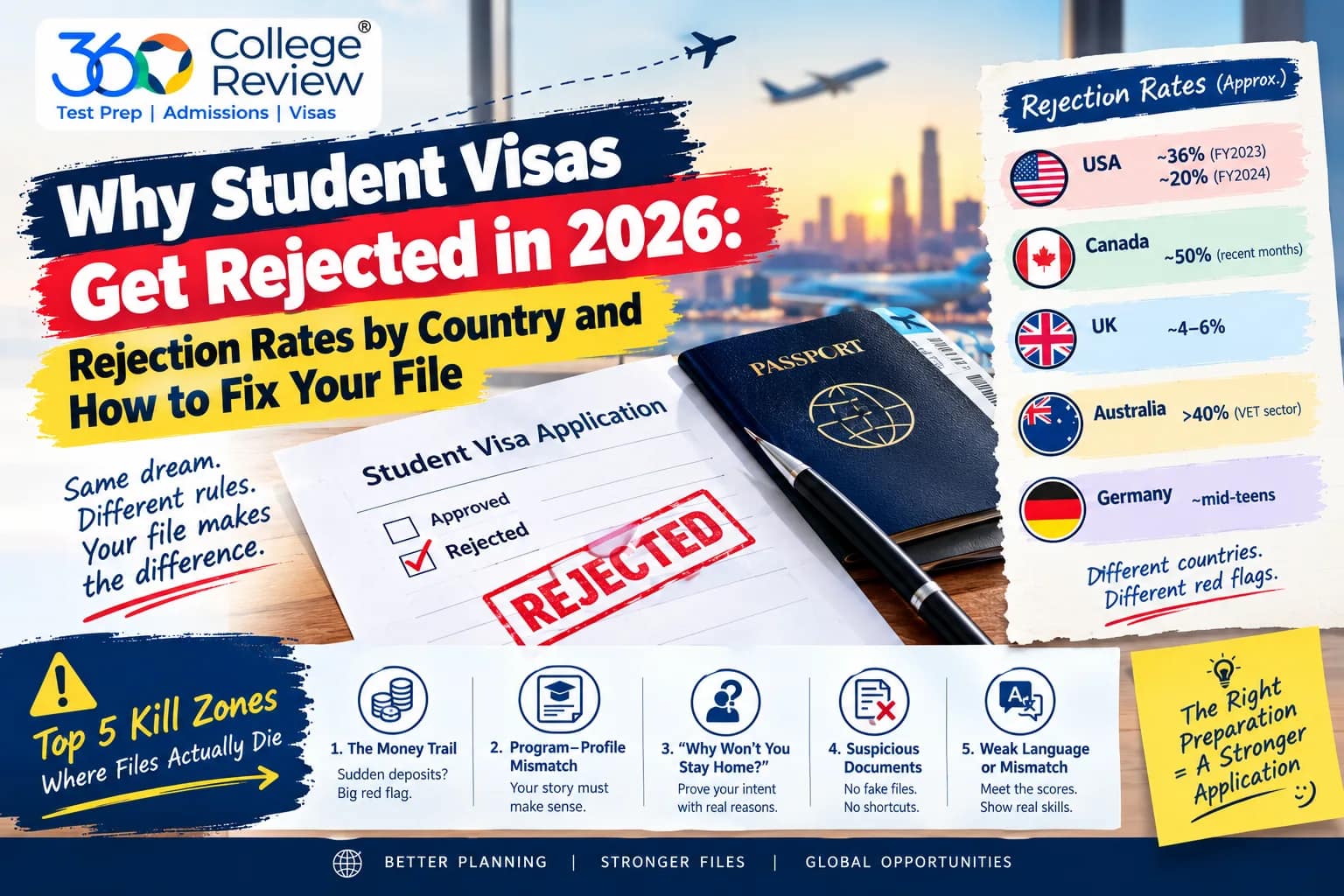
  • United States: roughly 36% of F-1 applications were refused in FY2023, easing toward roughly one in five in FY2024 as post-pandemic backlogs cleared. With interviews now largely mandatory again since September 2025 and expanded social-media vetting, rejections cluster around the famous 214(b) — “you have not convinced me you intend to return.”
  • Canada: the cap era has hit approval rates hard — from approval rates around 74% in the boom years down to roughly half of study-permit applications being approved in recent months (per IRCC data widely reported into 2025). Financial documentation is the single biggest kill zone.
  • United Kingdom: still the strictest-sounding process with the lowest refusal rates — typically around 4–6% for student visas. But rising scrutiny includes credibility interviews where officers test whether you genuinely know your own course.
  • Australia: the Genuine Student test (replacing GTE in March 2024) has cut approvals sharply in the vocational-education (VET) sector — where refusal rates have been reported well above 40% — while university applications fare considerably better.
  • Germany: student visa refusals typically run in the mid-teens percentage-wise, with the APS certificate doing much of the pre-filtering that keeps refusals lowest among the big destinations.

Read those five numbers again. The same student can be a 95% approval candidate in London and a coin-flip in Toronto — purely because each country’s officers are trained to hunt different weaknesses.

The Five Kill Zones — Where Files Actually Die

1. The money trail. Every country audits your ability to pay; all of them are alert to last-minute money. Canada doubled its financial bar to C$22,895 GIC for a single applicant (from September 2025) and scrutinises every large recent deposit. The fix: build six months of clean, ordinary bank history — salary credits, rental income, matured FDs, all explainable. Money that arrives suddenly is money that gets questioned.

2. Program–profile logic. An applications officer reads your history like a detective reads a room. A biology graduate applying to a master’s in hospitality management in Dublin invites the question the officer is trained to ask: why? The fix is narrative and course selection together — pick programs that extend your story, and write the statement of purpose that connects your past to your future in one visible thread.

3. The “why won’t you stay home” suspicion. This is the 214(b) test in the US, the Genuine Student test in Australia, and a soft version of it everywhere. The fix isn’t memorised answers — officers hear those daily. It’s specificity: a named program, named faculty, a job type, a salary trajectory at home, and reasons your life is anchored in India (family business, property, a career ladder that only this degree completes).

4. Documents that whisper “agent made this.” Forged financials and template SOPs are epidemic — and detection keeps improving. A caught fake isn’t a refusal; it’s often a five-year ban. The fix is ruthless honesty plus your own voice. If your SOP could belong to any of 4,000 students, rewrite it until it belongs to you.

5. Weak language evidence or mismatch. Borderline scores, score-section imbalance (a 8.5 in speaking with a 5.5 in writing gets attention), or skipping formal testing altogether. Australia’s credibility checks and UK’s credibility interviews both probe whether your spoken English matches your certificate. The fix: sit the test properly, prepare the speaking/writing sections like exams, not formalities.

Country-Specific Pre-Flight Checks

  • For the US: rehearse a 90-second answer for why this university that mentions real department names; know your tuition number and who pays it; expect questions about post-study plans and answer in a nonimmigrant frame (career plans back home, family anchors). And clean up your public social media — vetting includes it now.
  • For Canada: assemble the GIC (C$22,895 single applicant, effective September 2025) plus first-year tuition proof before anything else; attach a clean LOE (Letter of Explanation) where any oddity in funds exists; choose PGWP-eligible programs so your post-study story is legitimate, not improvised.
  • For the UK: know your CAS details cold; be ready for a credibility interview on course content, modules and career use; ensure maintenance funds have sat in acceptable accounts for 28 days minimum before submitting.
  • For Australia: write a genuine-student statement that addresses cost-benefit of the course in your career; avoid the diploma-mill sector unless it genuinely fits (their refusal rates tell you the scrutiny level); health insurance and funds evidence per the visa checklist.
  • For Germany: complete the APS certificate first — applications without it fail on procedure; show the blocked account (€11,904/year at the January 2025 rate); prepare for interviews that test genuine academic intent.

Final Thoughts

Visa rejections in 2026 are rarely about who deserves to go — they’re about who documents their life well. I’ve watched students with average scores sail through Toronto interviews because their file was airtight and their story was true, and toppers stumble in Delhi because a cousin “helped” with the bank papers. You don’t need to be wealthy; you need to be legible. Give the officer a story so complete they don’t need to invent one. And when a file has any wrinkle — a gap year, a switched stream, borrowed seed money — that’s exactly when you bring it to a counsellor before submission, not after a refusal. At 360 College Review we run file audits that simulate the officer’s eye; it’s the least dramatic service we provide and the most often life-changing. Book one at 360collegereview.com before your interview slot arrives.

– The Author is Mr. Ajay Thiara, Founder & Managing Director of 360 College Review
Frequently Asked Questions

Which country has the highest student visa rejection rate currently?

Percentages vary by sector: Australia’s VET (diploma) applications show refusals reportedly above 40%; Canada’s overall approval rate has fallen to roughly half in recent months. The US refusal rate for F-1 was about 36% in FY2023, easing since. The UK remains lowest at roughly 4–6%.

I received funds from a property sale last month. Will that hurt me?

Not inherently — but it needs clean documentation: sale deed, tax records, transfer trail. Sudden unexplained deposits are what trigger suspicion. Attach the paperwork and a letter of explanation; never fund a visa with undocumented last-minute cash.

What is a 214(b) refusal and can I reapply?

It’s the US refusal citing “nonimmigrant intent” — the officer wasn’t convinced you’d return. Reapplication is allowed whenever your circumstances or evidence meaningfully change; a reheated identical file usually returns the same answer.

Does a gap year mean automatic rejection?

No — unexplained gaps do. An admitted gap with evidence (skilled work, certification, exam preparation) is normal. Write it into your SOP truthfully and keep proof documents ready.

Do agents’ “guaranteed visa” services actually help?

There is no such guarantee — officer discretion is discretionary. What helps: genuine documents, a consistent story, and your own voice. Fake documents risk multi-year bans; a counsellor’s job is risk-reduction, not fabrication.

How much bank balance should I show for Canada?

The GIC of C$22,895 (single applicant, effective 1 September 2025) plus first-year tuition. Beyond that, show a normal, healthy family trail rather than a padded, odd-looking balance.

What is a UK credibility interview?

A short interview (often by video) checking that you genuinely know your course, university, funding and plans. Students who can’t describe their own program get flagged. Prepare like an exam: modules, fees, career logic.

Can a refusal hurt my future applications?

A genuine refusal documented properly is a setback, not a stain — most people reapply successfully after fixing the file. A fraud-based refusal (fake documents) can mean bans that reshape your whole academic timeline.

Is student visa rejection higher for certain courses?

Yes — vocational/diploma programs with weak career logic face the deepest scrutiny (see Australia’s VET numbers). Degree programs with clear progression lines are scrutinised far less.

Does 360 College Review do pre-submission file audits?

Yes — document review, funds-trail structuring, SOP rewriting in your own voice, and mock interviews for the US/UK/Germany/Australia formats. Book at 360collegereview.com — ideally 2–3 months before your visa appointment.