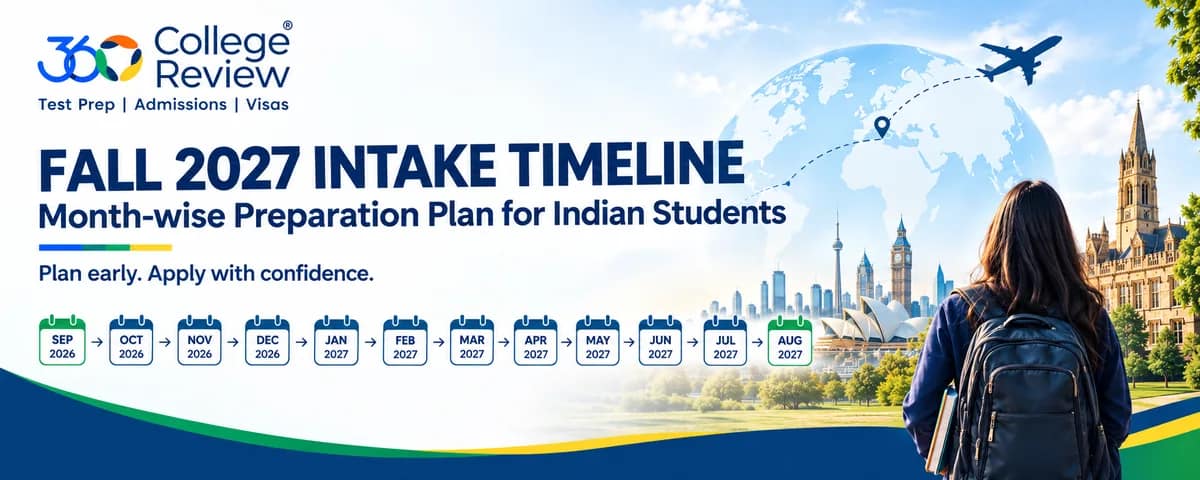
Here is what the Fall 2027 intake timeline looks like for students who want to study abroad. Note that the students who actually get selected in the top universities are not the ones who were the best on paper; they were the ones who started the earliest.
Fall intake (August/September 2027) is the largest intake for most universities across the world. This means that: (a) most universities have the largest number of seats available during the Fall intake, (b) most scholarship opportunities are available, and (c) the competition is the toughest.
In short, you don’t want to miss a single deadline because the opportunity might never come again.
Let us now walk you through a month-wise plan that will help you get a good overseas university.
September 2026: Research & Shortlist
You are already late if you have not started preparing yet. But it is never too late to start the process.
- Finalize your preferred countries. You can choose from a wide range of countries (considering budget, course availability, post-study work rights, and visa rules) including Canada, the USA, the UK, Australia, Ireland, New Zealand, Germany, and other European countries.
- Now, shortlist 8-10 universities. While finalizing the universities, make sure to balance between your reach, match, and safety options. You can base your shortlist on the ranking, course curriculum, fee structure, location, and employment rates.
- Browse through the university’s websites to get their Fall 2027 application deadlines. Remember that the application deadlines for the Fall intake in the US usually range from December 2026 to February 2027. The deadlines in the UK and Canada may go up to March-May 2027, but popular courses and universities have early deadlines.
- Take a free diagnostic English test. You can take a mock IELTS or PTE test to understand your current level of proficiency. If your score is below 6.0, you will need 3-4 months of dedicated IELTS or PTE coaching
October 2026: Test Prep & Documents
It is time to get serious and start test-prep and filling up documents
- Register for an English proficiency test, and take the test (IELTS, PTE, TOEFL, or DET). You can take the test in November or December 2026, but avoid taking it in January 2027 as the results may take longer to come in, and you risk missing the application deadline.
- Register for GRE/GMAT/SAT (if required by your target universities). Remember that the GRE has made a comeback in the US, and many top universities now require GRE scores for MS admissions.
- Start drafting your SOP. A rough draft will help you understand what you want to say about yourself and your career goals. Make sure to highlight why you want to pursue the course and why you want to join the specific university you are applying to
- Ask your recommenders (professors/mentors/employers) to write your LORs. Give them at least 6-8 weeks to submit the LORs, as they are often busy with their work
- Get your academic transcripts (mark sheets, diploma, or degree) ready. You will need to request your previous educational institutions to provide you with transcripts (official and sealed copy). It may take 2-3 weeks to get your transcripts.
November 2026: Take the Tests
- Take your English proficiency test (IELTS/ PTE/ TOEFL/ DET).
- Take your GRE/GMAT/SAT (if applicable). Note that the US universities are announcing a ban on the GRE. However, a lot of MS programs in CS, Data Science, and Engineering now require the GRE Scores again.
- Finalize your SOP based on the feedback from your counsellors. A good SOP can make all the difference, and you may need to go through 3-4 rounds of editing
- Prepare your resume/ CV. Make sure to mention your academic and professional qualifications and achievements in 1-2 pages.
- Create your accounts on the target university portals and fill the basic personal information
December 2026: First Wave of Applications
- Submit your applications to the universities with early deadlines in the US.
- Submit your applications to the universities with early deadlines in the UK (through UCAS) and Ireland (direct applications).
- Review the applications you have submitted and ensure that all required documents have been uploaded and received by the university (transcripts, scores, and LORs). It is a good idea to double-check everything as most applications get rejected due to incomplete documents.
January 2027: Second Wave of Applications
- Submit your applications to the remaining universities in the US with January deadlines. Make sure to submit your applications by the 15th of every month, as most top 50 US universities have application deadlines on or before 15th January 2027
- Submit your applications to the remaining UK and Irish universities. The application deadlines for most courses in the UK and Ireland range from February to March 2027.
February 2027: Europe and More UK
- Submit your applications to the German (Deadline: January-March 2027), Netherlands, Italy, and France universities with early deadlines.
- Submit your remaining UK applications (mostly for degree courses offered by the top 50 UK universities).
- Submit your applications to the Canadian universities. (February-April 2027). Always apply early if you are targeting a popular course (MS in CS, Data Science, Engineering) in a popular university (UBC, Toronto, Waterloo, McGill, etc.). If you start your application process in February, you are very likely to miss the early admission round.
March 2027: Final Round of Applications
Always apply early if you are targeting a popular course (MS in CS, Data Science, Engineering) in a popular university (UBC, Toronto, Waterloo, McGill, etc.). If you start your application process in February, you are very likely to miss the early admission round.
- Submit your applications to the remaining Canadian universities (UBC, Toronto, Waterloo, McGill, etc.).
- Submit your applications to the Australian and New Zealand universities. Most of New Zealand’s and Australia’s Semester 2 intake (July) has already closed, but you can still apply to some ANZ universities offering the Semester 1, 2028 intake (February 2028). However, a few ANZ universities offer rolling intake for the Fall 2027 intake, so it is worth checking.
- Start with the GIC and education loan processing if you have received a conditional offer from a Canadian university
- Respond to the interview call from the universities (if any). Some universities do offer interviews to shortlisted candidates, especially for their MBA, medical, and engineering programs. Interviews are usually held in March and April 2027.
April 2027: Offers & Decisions
- Look over your received offers and decide which offer you will accept. Always consider factors such as the fee structure, the university’s location, scholarships, specializations, and post-graduation work permit. Remember that top-ranked universities do not always guarantee a better package.
- Confirm your offer by paying the required deposit (this will secure your seat in the university). You will also receive your confirmation letter (CAS/COE/i20/LOA) after the deposit is made.
- Make an application for on-campus housing. Always apply as early as possible, as on-campus housing is extremely competitive. You can also start your off-campus housing search.
- Document preparation for visa application (financial proof, medical, passport, etc.). Always ensure that your passport is valid for at least 18 months from the start of your course.
May 2027: Visa Filing
- Make an application for a Student Visa in your target country (Canada: study permit with PAL; the USA: F-1 with I-20; the UK: Student Visa with CAS; Australia: subclass 500 with CoE; Ireland: Long Stay D visa).
- Make an appointment for your visa interview (biometrics appointment). The appointment booking process can be long, depending on the country and the current season.
- Loan Disbursement (if applicable)
- Make an application for your flight tickets. Remember that you can get student fares at heavily discounted prices. Student fares usually open 3-4 months in advance, and you can get the best fares in May and June 2027. Book a flight ticket as a round-trip ticket would be the most affordable option as international travel is expensive.
June 2027: Visa Results
- Apply for travel and health insurance. Most countries require you to have travel and health insurance.
- Receive your visa result (if you have not received your visa, consult your counsellor about the next steps).
- Apply for accommodation if you have not applied for on-campus accommodation. 360 College Review offers end-to-end visa filing services for all countries and visa categories.
- Book your accommodation (hostel or PG). You can apply for on-campus accommodation as early as June 2027. 360 College Review has tie-ups with popular PGs in Canada, the UK, and Australia to offer special rates and discounts to our students.
- Consult with your parents about final preparations. 360 College Review will conduct an exclusive pre-departure briefing every month in June and July 2027 for all our students.
- Make some travel provisions for the first month (approximately CAD $2,000-$3,000 or its equivalent in local currency). You will need this provision before your GIC / education loan gets credited to your account.
July 2027: Pre-Departure
- Pack suitable clothing for winter (in case you are joining a Canadian, UK, or European university)
- Set up a bank account (most Canadian and UK banks allow overseas students to open a bank account in India before reaching their host country).
- Buy a local SIM card
- Connect with your batchmates via Facebook and WhatsApp groups
- Say goodbye to your family and friends. It will be your last month in India.
August 2027: You’re Off
- You arrive in your host country 1-2 weeks before the start of the semester and freshen up
- Orientation program, bank account opening, and student ID card collection
- Register for courses. Apply for the modules you are interested in as they can get fully booked very fast.
- You can start looking for a part-time job (both campus and off-campus jobs are allowed in most countries), and you can work 20 hours per week.
What You Should Be Doing Right Now
If you are currently in September 2026, you are right on track! All you need to do now is take your IELTS test and shortlist your universities and start drafting your SOP.
If you need help shortlisting your universities or are stuck at any point in the application process, talk to one of our counsellors. They can guide you through the entire process and advise you on the next steps.