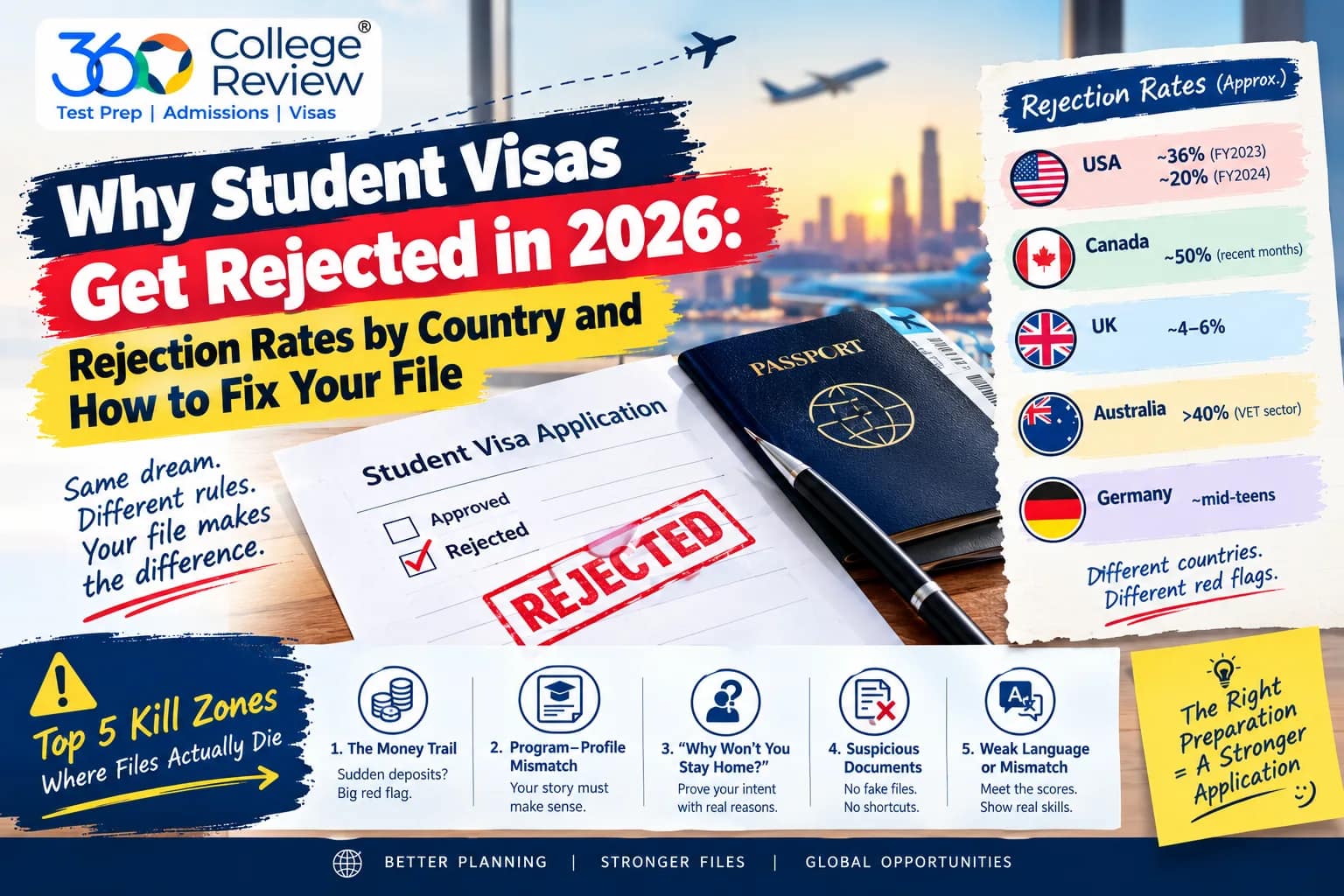
Every year, thousands of bright, fully-funded, genuinely serious Indian students lose their visas — not because they were frauds, but because their files looked like frauds. The difference between the student who flies in September and the one who re-applies in January is rarely merit. It’s the file. Today let me show you the actual rejection landscape across the five big destinations, what each country’s officers are currently hunting for, and a country-by-country fix list you can use before you submit anything.
Read those five numbers again. The same student can be a 95% approval candidate in London and a coin-flip in Toronto — purely because each country’s officers are trained to hunt different weaknesses.
1. The money trail. Every country audits your ability to pay; all of them are alert to last-minute money. Canada doubled its financial bar to C$22,895 GIC for a single applicant (from September 2025) and scrutinises every large recent deposit. The fix: build six months of clean, ordinary bank history — salary credits, rental income, matured FDs, all explainable. Money that arrives suddenly is money that gets questioned.
2. Program–profile logic. An applications officer reads your history like a detective reads a room. A biology graduate applying to a master’s in hospitality management in Dublin invites the question the officer is trained to ask: why? The fix is narrative and course selection together — pick programs that extend your story, and write the statement of purpose that connects your past to your future in one visible thread.
3. The “why won’t you stay home” suspicion. This is the 214(b) test in the US, the Genuine Student test in Australia, and a soft version of it everywhere. The fix isn’t memorised answers — officers hear those daily. It’s specificity: a named program, named faculty, a job type, a salary trajectory at home, and reasons your life is anchored in India (family business, property, a career ladder that only this degree completes).
4. Documents that whisper “agent made this.” Forged financials and template SOPs are epidemic — and detection keeps improving. A caught fake isn’t a refusal; it’s often a five-year ban. The fix is ruthless honesty plus your own voice. If your SOP could belong to any of 4,000 students, rewrite it until it belongs to you.
5. Weak language evidence or mismatch. Borderline scores, score-section imbalance (a 8.5 in speaking with a 5.5 in writing gets attention), or skipping formal testing altogether. Australia’s credibility checks and UK’s credibility interviews both probe whether your spoken English matches your certificate. The fix: sit the test properly, prepare the speaking/writing sections like exams, not formalities.
Visa rejections in 2026 are rarely about who deserves to go — they’re about who documents their life well. I’ve watched students with average scores sail through Toronto interviews because their file was airtight and their story was true, and toppers stumble in Delhi because a cousin “helped” with the bank papers. You don’t need to be wealthy; you need to be legible. Give the officer a story so complete they don’t need to invent one. And when a file has any wrinkle — a gap year, a switched stream, borrowed seed money — that’s exactly when you bring it to a counsellor before submission, not after a refusal. At 360 College Review we run file audits that simulate the officer’s eye; it’s the least dramatic service we provide and the most often life-changing. Book one at 360collegereview.com before your interview slot arrives.
– The Author is Mr. Ajay Thiara, Founder & Managing Director of 360 College Review