ClickCease

The $100,000 H-1B Fee: Your Realistic US Plan for 2027 Intake

The $100,000 H-1B Fee: Your Realistic US Plan for 2027 Intake

When the US government announced a $100,000 payment for new H-1B visa petitions in September 2025, my phone did the thing it always does after a headline like that — it lit up. Students mid-application. Parents mid-panic. And one worried father in Ludhiana who called to say he might need to stop his daughter’s GRE prep the very next morning.

Take a breath. The picture is complicated, but it is not the end of the road — and it is definitely not what most WhatsApp forwards told you. Let me walk you through what actually happened, what it means for you as an Indian student eyeing the 2027 intake, and how to rebuild your US plan so it survives.

What Actually Changed?

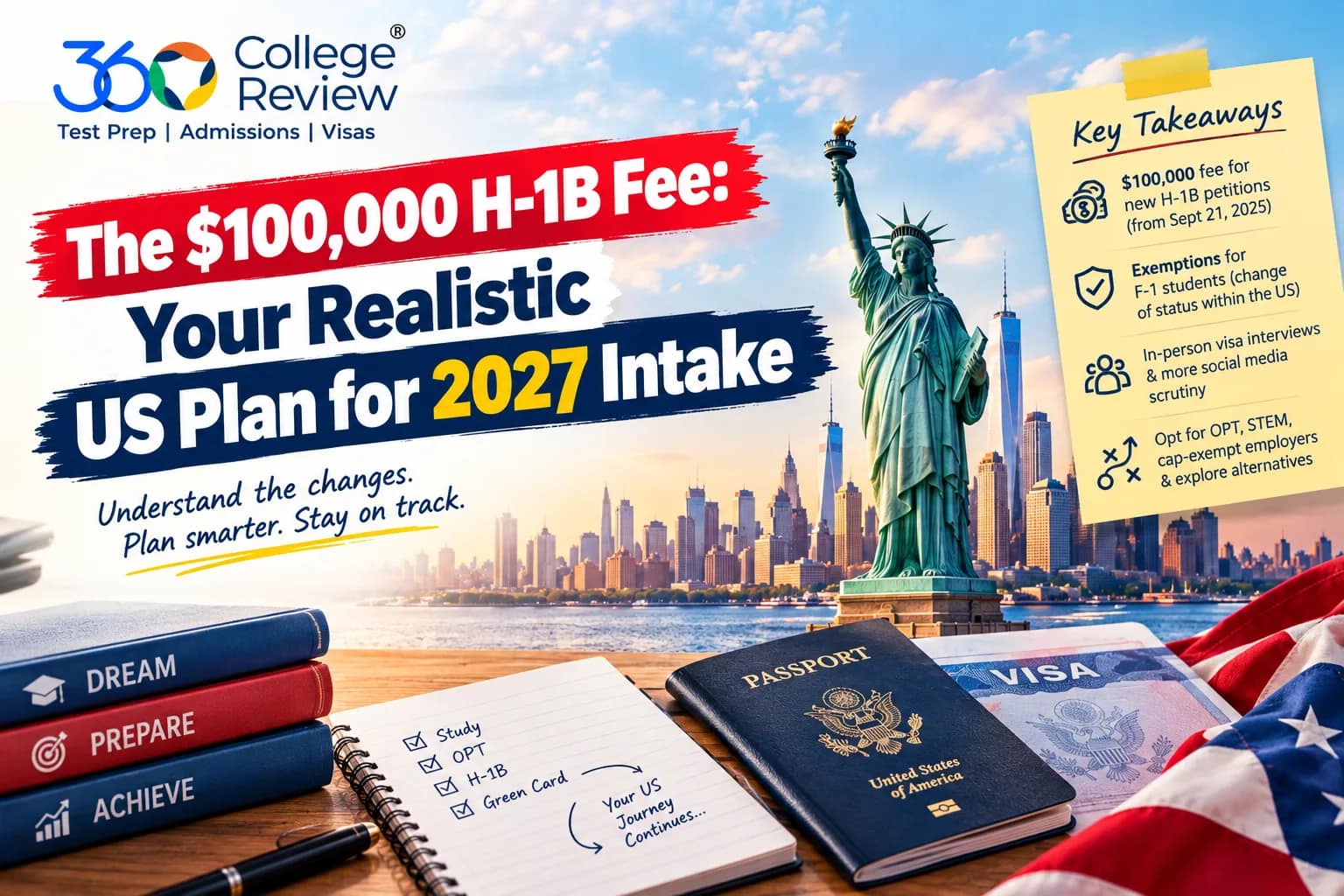
In September 2025, a presidential proclamation imposed a $100,000 payment requirement on new H-1B petitions filed from September 21, 2025 onwards. The H-1B, as you probably know, is the work visa most international graduates use to stay in the US after training. The regular cap of 65,000 visas plus another 20,000 for US master’s graduates — 85,000 in total — is unchanged.

Here’s the part that barely made the headlines, and it matters enormously: the proclamation comes with exemptions for anyone applying through “change of status” from inside the US — including students already in the country on F-1 visas doing their OPT (the practical training period after graduation). In plain language:

  • If you’re already studying in the US on an F-1 and switch to H-1B from within the country — the $100,000 payment does not apply to you under the current reading of the rule.
  • If your employer files a new petition for you from abroad (a consular filing) — that’s where the $100,000 lands.
  • The exact scope is still being clarified through USCIS guidance and legal challenges, so treat every “final” interpretation you hear with healthy suspicion.

You’ve probably also heard about the visa interview changes — and they’re real. Since September 2025, most applicants, including students, must attend in-person interviews again; the interview-waiver facility that saved many Indians a consulate trip has been substantially cut back. Social media scrutiny has also expanded — officers review your public online presence, and your DS-160 form asks about your social media handles. Nothing you post is private in the visa office’s eyes. Clean up, but don’t delete your identity — inconsistent handling of accounts can raise flags too.

Why This Changes Your Math (But Doesn’t Kill It)

Here’s the honest frame: the US remains the world’s largest destination for international students — over 1.17 million international students were enrolled there in 2023, and Indians are the second-largest group, over 3.3 lakh of us per Open Doors data. No single fee changes that gravity. What changes is who can afford to gamble on which strategy.

Think of it like this. The old US playbook was: study → OPT → H-1B lottery job → green card. That pathway still works — through the change-of-status exemption, a student who finishes their degree in the US and moves to H-1B from OPT-side is not paying $100,000. The people hit hardest are companies trying to import graduates directly from India. That’s a recruiting-firm problem more than a student problem — but it reshapes which jobs exist for new grads, because employers now weigh sponsorship costs before hiring anyone new.

The OPT-First Playbook

Your job as a 2027 applicant is to make OPT — Optional Practical Training — the spine of your plan, not H-1B.

  • Pick a STEM-designated program. OPT gives you 12 months of work authorisation after graduation; students in STEM-designated programs (there’s a DHS list covering hundreds of CIP codes) get a 24-month extension — 36 months total. Three years of legal work runway is the difference between “one lottery shot” and “three lottery attempts.”
  • Budget the actual application costs. The SEVIS (I-901) fee for F-1 students is $470 after the 2025 increase, the visa application fee is $185, and your I-20 will show your full program cost — often $40,000–$70,000 a year for a master’s degree. Plan your finances around all of it, not just tuition.
  • Target cap-exempt employers. Universities, university-affiliated hospitals and nonprofit research organisations are exempt from the H-1B lottery entirely. A research assistant role, a hospital informatics job, a nonprofit data role — these don’t need you to win a lottery. Thousands of Indian graduates quietly build careers this way.
  • Stack your backup documents. The O-1 (extraordinary ability) visa, National Interest Waiver EB-2 green card petitions, and cap-exempt H-1Bs are all real alternatives. None are “easy”, but all are cheaper than $100,000 and all reward the same thing: demonstrable, documented skill.

What About Getting the Visa Itself?

Expect the process to feel stricter than it did for the seniors who went before you.

  • Book your interview slot early. With waivers withdrawn for most categories, consular queues in Mumbai, Delhi, Hyderabad and Chennai have lengthened again.
  • Prepare for a genuine interview, not a formality. You’ll be asked why this university, how you’re funding it, and what you intend after graduating. Have clear, honest, specific answers. Vague answers invite refusals under 214(b).
  • Mind your digital footprint. Your social media is now part of the vetting file. You don’t need to be a monk — you need to be consistent.
  • Keep finances documentary. Six months of clean bank history, loan sanction letters, sponsor affidavits. Cash gifts landing the week before your interview are the classic red flag.

If the US Still Doesn’t Feel Right

You have excellent Plan B destinations, and the smartest 2027 applicants now maintain parallel files — not because they’re defeatists, but because policy risk is now a genuine variable.

  • Canada caps but still welcomes large numbers, with post-study work permits if you pick eligible fields.
  • The UK offers 18–24 months of post-study work (more on that in its own blog — the rules just changed).
  • Germany is nearly tuition-free for a genuinely top-tier engineering education.
  • Ireland, the Netherlands and the UAE — rising fast, English-friendly, and hungry for tech talent.

Final Thoughts

The $100,000 H-1B fee is a shock to the system, I won’t pretend otherwise. But shocks like this separate the planners from the dreamers — and you, the person still reading this at the fourth FAQ, are clearly a planner. The US is no longer a straight escalator to a green card; it’s a structured, strategic pathway where OPT design, employer type and timing decide everything. Get those three things right, keep your documents spotless, and the American chapter of your story is still very much open. And if it isn’t? Then you’ll be standing at the door of three other countries with the same excellent preparation. Either way, you win — because the preparation was never wasted. Talk to us at 360 College Review before you apply; one honest counselling hour beats a hundred confused forum threads.

– The Author is Mr. Ajay Thiara, Founder & Managing Director of 360 College Review
Frequently Asked Questions

Do I have to pay $100,000 for the H-1B if I study in the US first?

Under the current proclamation, petitioners filing a “change of status” from within the US — which is the standard H-1B route for students already on F-1 OPT — fall under exemptions. This is the scenario most Indian master’s graduates use. Keep watching USCIS guidance, because rules here are still evolving.

So who actually pays the $100,000?

Under the current rules, new cap-subject petitions filed from abroad — where the candidate has no existing US status — face the payment. That mostly affects companies recruiting directly from India, not students converting from OPT inside the US.

Is the H-1B lottery still random?

Yes. The regular cap of 65,000 plus 20,000 for US master’s graduates remains, and selection stays a lottery. A US master’s degree gives you two lottery entries in theory (the master’s cap and the regular cap).

What is OPT and why does everyone keep saying “OPT-first”?

Optional Practical Training is 12 months of work authorisation after graduation, extendable by 24 months for STEM-designated degrees. It needs no lottery and no employer sponsorship — you graduate, apply, and work. It’s now the safest first step of a US career.

Does the fee apply if I’m doing a PhD and plan to work in academia?

University employers are cap-exempt and file H-1Bs outside the lottery, so academic and nonprofit research routes are largely insulated from the fee.

I heard interviews are mandatory for students again — true?

Yes. Since September 2025 the interview-waiver facility is largely gone for most nonimmigrant categories. Expect an in-person interview at the consulate, longer slot waits, and expanded social media review during vetting.

Can I work part-time while doing my master’s in the US?

On-campus employment is allowed up to 20 hours a week during term. Off-campus work generally requires CPT (during study) or OPT/STEM OPT (after graduation). Unauthorised work is grounds for status termination — don’t risk it.

My GRE is done but I’m worried. Should I switch to Canada or the UK?

Decide on job-market physics, not fear. If your target is a niche tech or research career, the US still offers the deepest market. If your goal is shorter timelines and predictable rules, Canada, the UK and Ireland may genuinely fit better. A counsellor can map this to your profile in one sitting.

What’s the total budget for an MS in the US in 2027?

Public universities: roughly $35,000–$55,000 a year all-in; private universities: $60,000–$90,000 a year. Factor the $470 SEVIS fee, $185 visa fee, travel insurance and a job-search cushion of at least $4,000 in reserve.

Does 360 College Review help with OPT/H-1B strategy?

Yes — program selection (STEM designation matters!), university shortlisting, financial documentation and realistic career-path mapping are core to our counselling. Book a session at 360collegereview.com before you lock your applications.