Let me tell you about the most under-used door in American higher education. A student from Patiala came to my office two years ago with a modest budget, a decent 12th-grade score, and a very fixed notion that the US was “only for the rich.” I asked him one question: “Who told you you have to start at the university?” He stared at me. That confusion is exactly why I’m writing this — because the community college transfer route might just be the single most cost-effective way for an Indian student to earn an American degree in 2026–27.
What Is the 2+2 Route, Exactly?
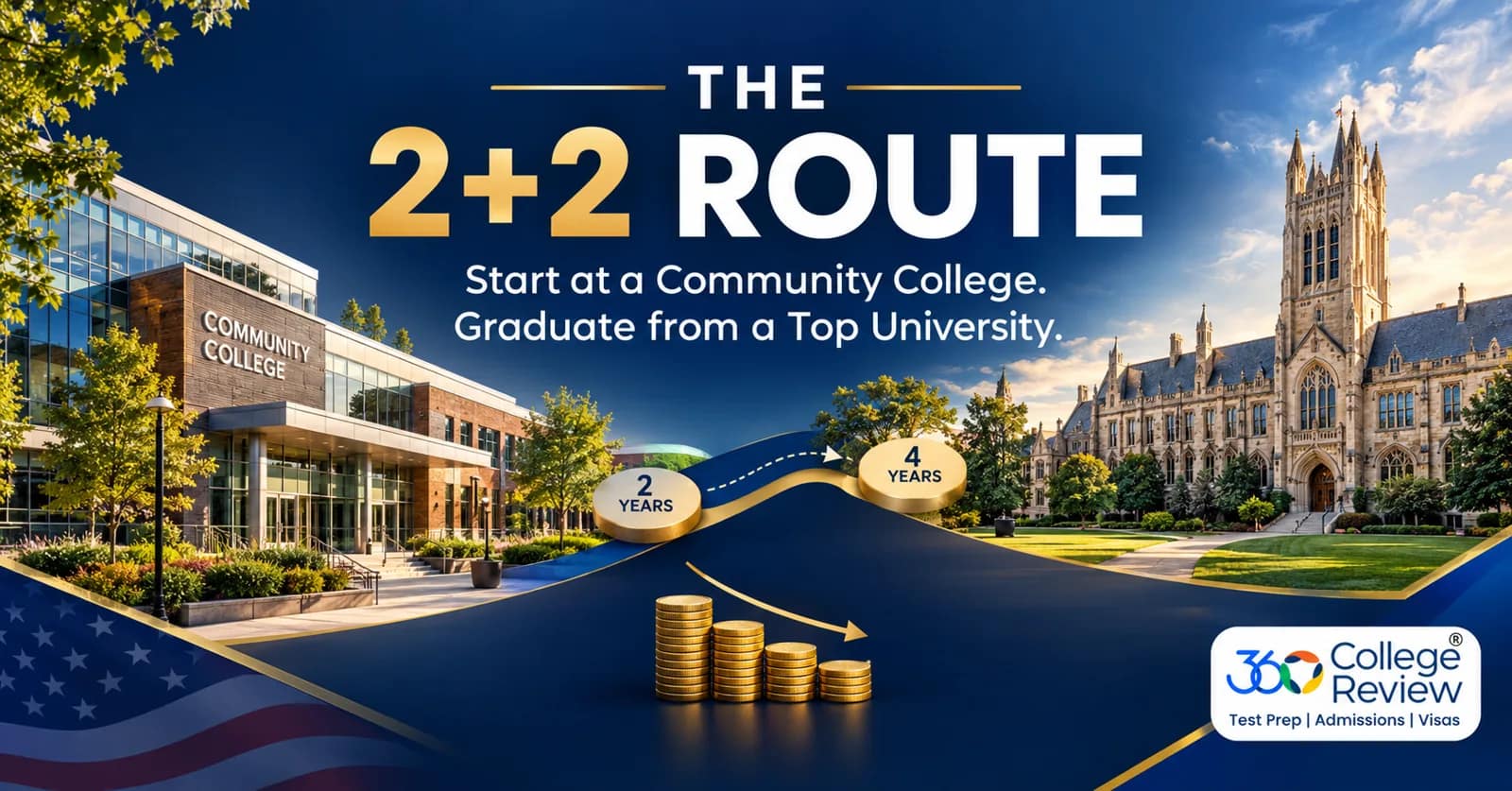
The United States has over a thousand community colleges — two-year public colleges offering Associate degrees. The system is built for transfer: you complete two years at the community college, transfer your credits into a four-year university, and finish your bachelor‘s degree there. You graduate with the same degree as someone who spent all four years on campus — the diploma does not announce where you started.
Roughly a quarter of American undergraduates begin their studies at community colleges. It’s not a back door; it’s a normal American route. International students number around 90,000 at US community colleges in recent years — a quiet, growing crowd that most Indian families have simply never been told about.
Why the Money Math Is Almost Absurd
Here’s the part that makes parents put their tea down and lean in.
- Community college tuition for international students typically runs $9,000–$12,000 a year, with living costs in college towns often $9,000–$14,000 a year.
- A public university’s out-of-state tuition is usually $30,000–$45,000 a year, and private universities push $60,000–$90,000 annually.
- Complete the first two years at a community college and you save $60,000–$100,000+ over the full degree — often ₹50 lakh to ₹90 lakh at typical exchange rates.
The diploma reads the same. The bank statement doesn’t. That’s the whole trick.
The Transfer Guarantee — Yes, Guarantees
This is the secret sauce: several US states run formal transfer guarantee systems.
- California’s TAG (Transfer Admission Guarantee) lets students at community colleges sign an agreement with universities like UC Davis, UC Irvine, UC Santa Barbara, UC Riverside, UC Santa Cruz and UC Merced — guaranteeing admission if you hit the required GPA and complete the agreed courses. The University of California system alone admits over 25,000 transfer students in a typical year, and they’re overwhelmingly drawn from California community colleges.
- Virginia’s system has a long-standing guaranteed admission agreement between Northern Virginia Community College and the University of Virginia — one of America’s most prestigious public universities — for students who meet GPA and course requirements.
- Community colleges maintain articulation agreements with hundreds of universities that tell you, course by course, exactly what will transfer. No guesswork.
UCLA and UC Berkeley don’t offer TAG, but they admit large transfer cohorts every year — and a well-prepared transfer applicant with a strong GPA often has a better shot through that door than through freshman admissions, where the competition for international seats is merciless.
Which Community Colleges Have Real Track Records?
A few names consistently draw and successfully place international students:
- Santa Monica College (California) — one of the highest-ranked transfer feeders into the entire University of California system.
- De Anza College and Foothill College (Silicon Valley, California) — strong engineering and CS transfer pipelines into San Jose State, UC campuses and beyond.
- College of DuPage (Illinois) — two-year pathways feeding Illinois public universities, minutes from Chicago’s job market.
- Diablo Valley College (California) — long experience with international transfers into UC and CSU.
- Green River College (Washington) — popular with international students, with direct university partnerships.
- Northern Virginia Community College (Virginia) — the UVA guaranteed-admission agreement, plus proximity to Washington DC’s tech and government market.
While studying, F-1 students can work on campus up to 20 hours a week. After transferring and finishing the bachelor’s, standard OPT rules apply — including the 24-month STEM extension for eligible majors, which carries the same value for you as for any US graduate.
The Honest Difficulties — Because You’ll Hear This From Me Always, Not Only the Rosy Bits
- You must actually perform. Transfer guarantees are conditional on GPA — commonly 2.8 to 3.5 depending on the agreement and major — and on completing the right courses. This route rewards discipline.
- Engineering majors are the hardest to map. Fine arts and business transfer easily; engineering sequences are strict. Work with an academic advisor from semester one.
- Housing and community. Community colleges often have limited student housing. Homestays and shared apartments are the norm — plan for it.
- Choose an accredited, transfer-focused college. Not every community college is created equal. Check their transfer statistics before you pay anything.
- Visa scrutiny is real. At the interview you must show a coherent plan: this college, this intended transfer, this career. It’s fully legitimate — but you need to narrate it well, with documented finances.
Who Should Seriously Consider This Route?
- Families with a budget ceiling who want the American degree without the American mortgage.
- Students whose 12th-grade results don’t match their true ability — the transfer system resets the playing field based on college performance.
- Students targeting STEM majors who want a second, more forgiving landing before top-university coursework.
- Anyone who wants to sample US education at lower stakes before committing four years.
Final Thoughts
The 2+2 route is not a consolation prize — it’s a chess move. You enter the American system through the side door, save the price of a Chandigarh apartment along the way, and walk out with a degree from a university your relatives will brag about at weddings. What it demands from you is clarity of plan and consistency of effort, which — let’s be honest — are exactly the qualities the US education system has always been testing. If you’d like help mapping a specific community college to a specific transfer target, with the real GPA numbers and credit-matching involved, that’s precisely the kind of planning session we do every day at 360 College Review. Book one before you apply. The right two-year start can change everything that follows.