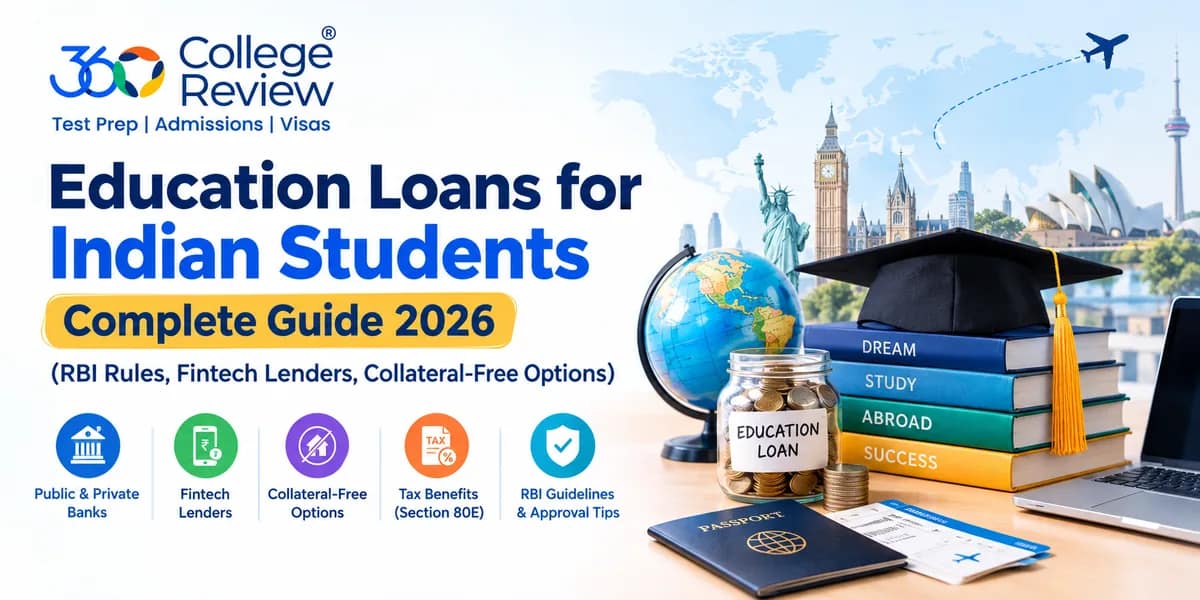
Education Loans for Indian Students: Complete Guide 2026 (RBI Rules, Fintech Lenders, Collateral-Free Options)
Let’s talk about the part of study abroad that makes Indian families more anxious than any other — funding. You’ve got the admission letter. You’ve got the visa. But the question that keeps everyone up at night is: “How do we pay for it?”
A quality education loan can make the difference between going to your dream university and settling for less. But most Indian families don’t know the full landscape — they think “SBI or nothing” and miss better options. Let’s fix that.
This is your complete guide to education loans for Indian students in 2026 — public banks, private banks, fintech lenders, collateral-free options, tax benefits, and how to actually get approved.
The Indian Education Loan Landscape — What’s Changed
The Indian government launched the Vidyasaarathi portal (managed by NSDL e-Governance) to help students find scholarships, and the Vidya Lakshmi portal (launched August 15, 2015) for education loans. As of 2020, 37 banks were registered on Vidya Lakshmi offering 137 loan schemes. The portal integrates with SBI, IDBI Bank, Bank of India, and 34 others.
The education loan market in India has been growing steadily — projected growth rates of 32–45% in the 2010s, and that growth has accelerated with the rise of fintech lenders and collateral-free loan products.
What’s Actually New in 2025–2026
Fintech lenders are now major players: Propelld, Eduvanz, Varthana, CreditBazzar, and others now offer education loans with faster processing and more flexible criteria than traditional banks
Collateral-free loans up to ₹75 lakhs: Previously capped at ₹40 lakhs, collateral-free (unsecured) loans have increased significantly
RBI has clarified education loan guidelines: Better consumer protection, clearer moratorium rules, and standardized processing timelines
Tax benefits under Section 80E are better understood: Full interest deduction for 8 years — many families don’t claim this
Digital processing: Most banks and fintech lenders now offer online applications with 7–15 day approval timelines (vs 30–60 days historically)
Types of Education Loans — Know Your Options
1. Secured Loans (With Collateral)
You pledge an asset — property, fixed deposits, or LIC policies — as security. In exchange, you get:
Lower interest rates: 9.5%–11.5% (vs 11.5%–13.5% for unsecured)
No collateral required. The loan is approved based on:
Academic merit: Your admission to a recognized university
Future earning potential: The bank’s assessment of your post-graduation income
Co-applicant income: Your parents’ or spouse’s income and credit score
University reputation: Top-ranked universities get easier approval
What you get:
Loan amount: Up to ₹75 lakhs (for top universities)
Interest rates: 11.5%–13.5% (higher than secured)
Tenure: Up to 10–12 years
Faster processing: 7–15 days (vs 30–45 for secured)
3. Government-Backed Loans (CSIS Scheme)
The Credit Guarantee Fund Scheme for Education Loans (CGFSEL) — backed by the Government of India — provides collateral-free education loans up to ₹7.5 lakhs without any collateral or third-party guarantee. This is specifically for loans up to ₹7.5 lakhs — beyond that, collateral is required.
Who qualifies: Indian students admitted to recognized institutions in India or abroad, with family income up to a specified threshold.
Major Lenders Compared
Public Sector Banks
Bank
Interest Rate (Secured)
Interest Rate (Unsecured)
Max Loan Amount
State Bank of India (SBI)
9.5%–10.5%
11.5%–12.5%
₹1.5 crore
Bank of Baroda
9.7%–10.7%
11.5%–12.7%
₹1 crore
Punjab National Bank
9.6%–10.6%
11.5%–12.5%
₹1 crore
Canara Bank
9.7%–10.7%
11.5%–12.5%
₹1 crore
Pros of public banks:
Lowest interest rates (especially secured)
Strong regulatory protection
Government-backed schemes available (CGFSEL)
Wide branch network for documentation
Cons of public banks:
Slower processing (30–45 days)
More documentation required
Stricter eligibility criteria
Branch visits often necessary
Private Sector Banks
Bank
Interest Rate (Secured)
Interest Rate (Unsecured)
Max Loan Amount
HDFC Credila
10.5%–11.5%
12.5%–13.5%
₹1 crore
Axis Bank
10.5%–11.5%
12.5%–13.5%
₹75 lakhs
ICICI Bank
10.5%–11.5%
12.5%–13.5%
₹1 crore
Avanse
10.5%–12.5%
12.5%–14%
₹75 lakhs
Pros of private banks:
Faster processing (7–15 days)
More flexible eligibility criteria
Better customer service
Online application and tracking
Often more willing to lend for top-ranked universities
Cons of private banks:
Higher interest rates
Stricter co-applicant income requirements
May require higher credit scores
Fintech Lenders (New Players)
Lender
Interest Rate
Max Loan Amount
Processing Time
Propelld
11%–14%
₹50 lakhs
5–10 days
Eduvanz
11%–14%
₹50 lakhs
5–10 days
Varthana
11%–14%
₹40 lakhs
7–14 days
CreditBazzar
12%–15%
₹30 lakhs
3–7 days
Pros of fintech lenders:
Fastest processing (3–10 days)
Most flexible criteria
Fully online application
Willing to lend for mid-tier universities
Often approve loans that banks reject
Cons of fintech lenders:
Highest interest rates
Shorter repayment tenure
May have hidden fees
Less regulatory protection than banks
Aggressive repayment terms
What Does an Education Loan Cover?
A comprehensive education loan typically covers:
Tuition fees — the largest component
Accommodation/hostel fees — on-campus or private housing
Books and study materials — textbooks, laptops, software
Travel expenses — flights to/from the destination country
Living expenses — food, transport, insurance, personal expenses
Visa and application fees — included in some loan products
Health insurance — required by most study destinations
Important: Check what your specific loan covers. Some banks include all components; others cover tuition only. The best loans cover “all education-related expenses” — confirm this in writing.
The Moratorium Period — Your Breathing Room
Education loans come with a moratorium period — a time when you don’t have to make full repayments:
Standard moratorium structure:
During the course: No repayments required
Plus 6–12 months after graduation: Grace period to find a job
Or 6 months after getting a job (whichever is earlier)
During moratorium:
Some banks charge simple interest (not compound) — much better for you
Some banks require you to pay just the interest during the course
Some banks require no payments at all during moratorium
Read the fine print: “Simple interest during moratorium” is significantly better than “compound interest during moratorium.” Over a 2-year master’s, the difference can be ₹2–4 lakhs.
Tax Benefits — Section 80E (Don’t Miss This)
Under Section 80E of the Income Tax Act, you can claim a full deduction on the interest paid on your education loan — with no upper limit.
How it works:
Deduction available for: Interest paid on education loan (not principal)
Duration: Up to 8 years from the year you start paying interest
No limit: The entire interest amount is deductible — no cap
Eligibility: Loan must be for higher education (after Class 12) for yourself, spouse, or children
Lender must be: A bank or financial institution approved by the government
Example:
If you pay ₹5 lakhs in interest in a year, you can deduct the entire ₹5 lakhs from your taxable income. At a 30% tax bracket, that’s ₹1.5 lakhs in tax savings per year. Over 8 years, the savings can be substantial.
Most families don’t claim this. Don’t be one of them. Talk to your CA.
How to Get Approved — Step by Step
Step 1: Get Your University Admission Letter
This is the foundation. No admission letter = no loan. The better the university, the easier the loan approval.
Step 2: Choose Your Lender Strategically
Targeting top-100 global universities? Apply to private banks (HDFC Credila, Axis, ICICI) — they’re fastest for top-tier applicants
Need the lowest interest rate? Apply to public banks (SBI, BoB) with collateral
Need fast approval with no collateral? Apply to fintech lenders (Propelld, Eduvanz) — but accept higher rates
Loan under ₹7.5 lakhs? Use the CGFSEL scheme — no collateral required
Step 3: Prepare Your Documents
Standard document checklist:
Admission letter from the university
Fee structure from the university
Mark sheets (Class 10, 12, and any degree)
Income proof of co-applicant (salary slips, ITR for 2–3 years)
Bank statements (6 months)
PAN card and Aadhaar card
Property documents (if secured loan)
Passport copy
Step 4: Apply Online + Offline
Apply through the Vidya Lakshmi portal for public banks — single application, multiple banks
Apply directly to private banks’ websites — faster processing
Apply to 1–2 fintech lenders simultaneously as backup
Step 5: Follow Up Aggressively
Banks don’t proactively update you. Call weekly. Visit the branch if needed. Have all documents ready. The squeaky wheel gets the loan.
Common Rejection Reasons — and How to Avoid Them
Low co-applicant income: Co-applicant should ideally earn ₹6–10 lakhs/year minimum for unsecured loans
Poor credit score (CIBIL): Ensure your co-applicant’s CIBIL score is 750+ before applying
University not on approved list: Banks maintain lists of “approved” universities — check before applying
Insufficient collateral value: For secured loans, collateral should cover at least 100% of loan amount
Course not considered “employable”: Some banks reject loans for courses with poor job prospects — STEM and business are safest
Final Thoughts
Education loans in India have evolved dramatically. You no longer need to accept the first offer from your local SBI branch. With collateral-free loans up to ₹75 lakhs, fintech lenders processing in 5–10 days, and tax benefits that can save you lakhs — the system is more accessible than ever.
But the responsibility is on you to shop around. Compare interest rates, moratorium terms, processing fees, and tax benefits across 3–4 lenders before committing. Talk to a CA about Section 80E. And most importantly — borrow only what you need, not what you’re eligible for.
A well-structured education loan is an investment in your future earning potential. A badly structured one can burden you for 15 years. Choose wisely.
– The Author is Mr. Ajay Thiara, Founder & Managing Director of 360 College Review
Frequently Asked Questions
How much education loan can I get without collateral?
Up to ₹7.5 lakhs under the government's CGFSEL scheme (collateral-free, no third-party guarantee). For top-ranked universities, private banks and fintech lenders offer collateral-free loans up to ₹40–75 lakhs based on academic merit, university reputation, and co-applicant income.
What is the interest rate on education loans in India?
Secured loans (with collateral): 9.5%–11.5%. Unsecured loans (without collateral): 11.5%–13.5% from private banks, 11%–14% from fintech lenders. Public banks offer the lowest rates, fintech lenders are highest but fastest.
What is the moratorium period on an education loan?
Typically the course duration plus 6–12 months after graduation (or 6 months after getting a job, whichever is earlier). During moratorium, you may pay simple interest only, or nothing at all, depending on the bank. Simple interest during moratorium is significantly better than compound interest.
What is Section 80E tax benefit and how much can I save?
Section 80E allows full deduction of interest paid on education loans for 8 years — no upper limit. If you pay ₹5 lakhs interest in a year, you deduct ₹5 lakhs from taxable income. At 30% tax bracket, that's ₹1.5 lakhs saved per year. Most families don't claim this — talk to your CA.
Which is better — public bank or private bank for education loans?
Public banks (SBI, BoB, PNB) offer lower interest rates but slower processing (30–45 days) and stricter criteria. Private banks (HDFC Credila, Axis, ICICI) offer faster processing (7–15 days) and more flexibility but higher rates. Choose public banks for lowest cost, private banks for speed, fintech lenders for approval when banks reject.
What documents do I need for an education loan?
Admission letter, fee structure from university, Class 10/12 and degree mark sheets, co-applicant income proof (salary slips, 2–3 years ITR), 6 months bank statements, PAN and Aadhaar cards, property documents (if secured), passport copy. Have everything ready before applying to avoid delays.
Can I get an education loan for any university abroad?
Most banks maintain a list of “approved” universities — typically top-ranked institutions. Loans for universities on this list get faster approval and better terms. For universities not on the list, approval is harder and may require collateral or a guarantor. Check with your bank before applying.
How long does education loan approval take?
Public banks: 30–45 days. Private banks: 7–15 days. Fintech lenders: 3–10 days. Processing is faster if your documents are complete and your university is on the bank's approved list. Follow up weekly — banks don't proactively update you.
Can I prepay my education loan?
Yes — most education loans allow prepayment without penalty after the moratorium period. Prepaying saves significant interest. Some banks charge a small prepayment fee (1–2%) — check your loan agreement.
What happens if I can’t repay my education loan?
Defaulting on an education loan damages your CIBIL score, affects your co-applicant's credit, and can lead to legal action. If you're struggling, contact your bank immediately — most offer restructuring, extended tenure, or temporary moratorium extensions. Don't ignore the problem — communicate early.