
ClickCease

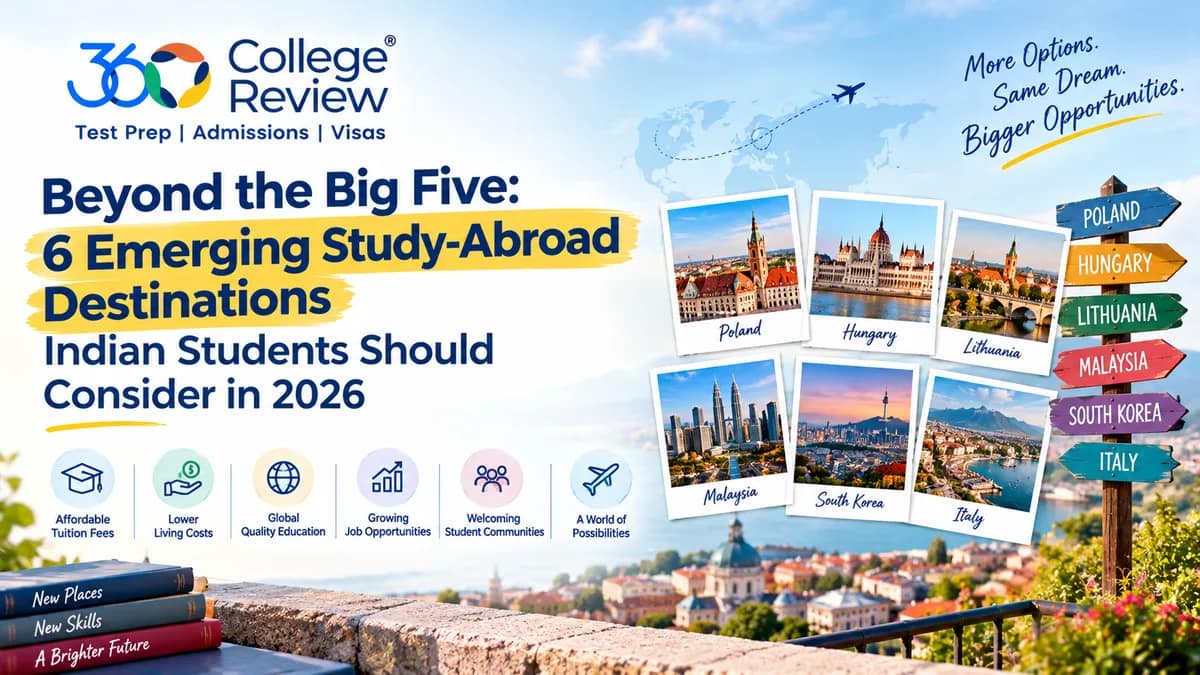
Beyond the Big Five: 6 Emerging Study-Abroad Destinations Indian Students Should Consider in 2026

Beyond the Big Five: 6 Emerging Study-Abroad Destinations Indian Students Should Consider in 2026

Let’s be honest: when most Indian students think about studying abroad, their minds jump to the same places. Canada. USA. UK. Australia. Maybe Germany.

But here’s what I’ve noticed over the past two years — the students who come to me with a genuinely strategic plan often have a different list. They might include Poland. Or Hungary. Maybe they’re looking at Lithuania, or Malaysia, or even South Korea. They see what many of their peers don’t: that the traditional destinations are getting more expensive, more competitive, and in some cases, less welcoming to international students. Meanwhile, a new generation of study-abroad countries is actively investing in attracting exactly the kind of ambitious, qualified international students that India produces in abundance.

I’m not saying Canada or the USA are bad choices — they’re not. But if you’re the kind of student who plans ahead, thinks strategically, and wants to maximize the return on your education investment, these emerging destinations deserve a look.

Here are six countries that are genuinely worth your attention in 2026.

1. Poland: Europe’s Best-Kept Secret

Poland has been quietly building one of Central Europe’s most respected higher education systems, and the numbers are starting to turn heads.

Why Poland is having a moment:

  • Tuition: €2,000–€7,000 per year for international students at public universities — some of the lowest in Europe
  • Living costs: €500–€800 per month — among the most affordable in Europe
  • Top universities: University of Warsaw (ranked in top 350 globally), Jagiellonian University (Cracow — one of Europe’s oldest, founded 1364), Warsaw University of Technology, and Poznan University of Technology
  • English-taught programmes: Over 600 English-taught programmes available — particularly strong in medicine, engineering, IT, and business
  • Post-study work: Poland offers a 12-month job search visa after graduation; the economy is growing rapidly with particular demand for IT, finance, and manufacturing professionals

Why it matters for Indian students:

Poland has a growing Indian student community (approximately 8,000 Indian students in 2024, up from under 2,000 in 2018), concentrated in medical programmes, IT, and management. The Polish government has made internationalisation a priority — universities have dedicated international offices, English-language support services, and active student societies.

The Polish economy grew by 2.8% in 2024 despite European headwinds, and cities like Warsaw, Kraków, and Wrocław have vibrant startup scenes, multinational offices (including Google, Amazon, and Microsoft regional hubs), and relatively low unemployment. IT professionals in Poland earn an average of €35,000–€55,000 per year — lower than Western Europe, but with a significantly lower cost of living.

Watch out for: Polish weather (cold winters, particularly in the east), the language barrier outside major cities, and the relatively smaller Indian community compared to Western Europe — though this is changing rapidly.

2. Hungary: Historic Quality, Modern Opportunity

Hungary sits at the crossroads of Central Europe, and its universities have been quietly producing world-class graduates for centuries. The University of Szeged, Eötvös Loránd University (Budapest), and Budapest University of Technology and Economics (BME) are all well-regarded regionally.

Why Hungary is interesting:

  • Tuition: €3,000–€8,000 per year at public universities
  • Living costs: €500–€750 per month — very affordable by Western European standards
  • Medical programmes: Hungary has become a major destination for international students seeking MBBS/MD programmes — the Semmelweis University in Budapest is one of Europe’s leading medical schools, offering English-taught programmes at approximately €12,000–€16,000 per year (significantly cheaper than equivalent programmes in the UK or US)
  • PhD opportunities: Hungary has a strong research culture, particularly in life sciences, engineering, and computer science. PhD stipends are available and often include full tuition waivers plus living allowances
  • Post-study: Graduates can transition to a job search visa of up to 9 months, with pathways to work permits for skilled occupations

Why it matters for Indian students:

Hungary’s medical programmes have been attracting Indian students for years — particularly those seeking an affordable European medical degree. The degree is recognized by the NMC (National Medical Commission) for Indian students who wish to return and practice in India, subject to licensing exams. If you’ve been priced out of MBBS in the UK or Ireland, Hungary is worth serious consideration.

Watch out for: Hungarian language is notoriously difficult; outside Budapest, English may not be widely spoken. The political situation in Hungary has created some tensions with EU academic freedom norms — worth reading recent academic freedom reports before committing.

3. Malaysia: The Asian Bridge

Malaysia is often overlooked by Indian students who think “study abroad” must mean going West. But Malaysia has quietly built a genuinely impressive higher education sector, particularly through its growing portfolio of branch campuses from top UK, Australian, and American universities.

Why Malaysia stands out:

  • Branch campuses of world universities: You can earn a University of Nottingham (UK) degree in Kuala Lumpur, or a Monash University (Australia) degree in Malaysia — at a fraction of the cost of studying on the home campus
  • Tuition at branch campuses: MYR 40,000–80,000 per year (approximately ₹7–14 lakhs) for UK/Australian degrees — versus £20,000–35,000 in the UK or AUD 40,000–55,000 in Australia
  • Living costs: MYR 2,000–3,500 per month (approximately ₹35,000–60,000) — including accommodation, food, and transport
  • Top local universities: Universiti Malaya (UM), Universiti Putra Malaysia (UPM), and Universiti Kebangsaan Malaysia (UKM) — all ranked in Asia’s top 50
  • Post-study: Malaysia offers a 12-month pass for graduates to seek employment; the country’s Multimedia Super Corridor (MSC) status has attracted major tech companies including Google, Microsoft, and IBM to set up regional operations

Why it matters for Indian students:

The cultural proximity is genuinely significant. Malaysia has a substantial Indian Malaysian community — approximately 2.1 million people of Indian descent — which means Indian culture is visible and respected. Food, festivals, temples, and Bollywood are all part of the cultural landscape. For students who are nervous about culture shock, Malaysia offers a bridge between home and the West.

The Malaysia My Second Home (MM2H) programme provides long-term residency options for graduates who wish to stay and work.

Watch out for: Salary levels in Malaysia are lower than in Western countries — average graduate salaries are MYR 3,000–5,500 per month. Malaysia is best considered as a stepping stone to Western education (through the branch campus pathway) rather than a final career destination for most Indian students.

4. South Korea: The Tech Powerhouse You Haven’t Considered

South Korea punches far above its weight in global technology and innovation — and its universities reflect that. KAIST (Korea Advanced Institute of Science and Technology) consistently ranks among the world’s top 50 universities and is particularly renowned for engineering, robotics, AI, and semiconductor research.

Why South Korea is gaining attention:

  • World-class STEM: South Korea invests heavily in research and development — approximately 4.8% of GDP (among the highest globally). Universities like KAIST, POSTECH, Seoul National University (SNU), and Korea University are leaders in semiconductor technology, AI, 5G/6G communications, automotive engineering, and biotech
  • Tuition: ₩4,000,000–₩8,000,000 per semester (approximately ₹2.4–5 lakhs) — subsidized by the Korean government for international students in government-funded programmes
  • Scholarships: The Korean Government Scholarship Programme (KGSP) covers tuition, living expenses (₩900,000/month), airfare, and Korean language training for selected international students
  • Living costs: ₩1,000,000–₩1,500,000 per month (approximately ₹60,000–90,000) in Seoul; cheaper in other cities like Busan, Daejeon, or Daegu
  • Post-study: The Academic (D-2) visa allows graduates to transition to an Employment (E-7) visa for skilled workers, with a pathway to permanent residency for those who accumulate sufficient pension contributions

Why it matters for Indian students:

If you’re serious about semiconductor technology, AI, robotics, or next-generation communications, South Korea is a genuine alternative to the US or UK — with potentially better funding availability for research students. Samsung, SK Hynix, LG, and Hyundai collectively represent one of the world’s most powerful technology and manufacturing ecosystems, and they actively recruit from Korean universities.

K-pop and Korean dramas are popular in India, but South Korea as a study destination is still massively underpenetrated among Indian students. The competition for admissions is therefore lower than in Western countries.

Watch out for: Korean language is essential for daily life outside the university — start learning before you go. The work culture in Korea is known for long hours. The climate ranges from hot/humid summers to cold, snowy winters.

5. Lithuania: The Baltic Fast-Track

Lithuania is the largest of the three Baltic states, and it’s making a determined push to attract international students. The country’s universities have modernised rapidly since EU accession, and the government’s National Internationalisation Action Plan has set ambitious targets for increasing foreign student numbers.

Why Lithuania is worth a look:

  • Tuition: €1,500–€4,500 per year at public universities
  • Living costs: €400–€700 per month — the cheapest in the EU for students
  • English-taught programmes: Over 200 English-taught programmes available
  • Post-study: Lithuania offers a 12-month job search visa after graduation, and the country has a growing IT and fintech sector in Vilnius — home to the European Banking Authority and numerous fintech startups
  • EU membership: As an EU country, a degree from Lithuania gives you a Post-Study Work Visa valid across the EU — you can seek employment in any EU country after graduation
  • Fast-track to residency: Lithuania has one of the fastest pathways to EU permanent residency — typically 5 years of continuous legal residence, which can include time as a student

Why it matters for Indian students:

Lithuania is genuinely one of the most affordable, least bureaucratic, and most quietly welcoming EU countries for international students. The Indian community is small but growing. Vilnius is a beautiful, walkable city with a vibrant old town — often cited as one of Europe’s most picturesque capitals. The Baltic coast (Klaipėda) and the Curonian Spit (a UNESCO World Heritage Site) offer unique natural environments.

The Startup Visa Lithuania programme is particularly interesting for entrepreneurial students — you can apply for a startup founder visa if you have a viable business concept.

Watch out for: Cold winters (similar to northern India in winter, but with less sunlight in December–January). A small country — the total international student population is around 5,000, so the community is intimate. Lithuanian language is unique (neither Slavic nor Germanic) — but English is widely spoken, especially among younger people.

6. Czech Republic: Central Europe’s Hidden Gem

The Czech Republic has a long tradition of academic excellence — Charles University in Prague, founded in 1348, is one of the oldest universities in the world. Prague is consistently ranked as one of the world’s most beautiful cities, and the Czech Republic offers a uniquely affordable European education experience.

Why the Czech Republic deserves attention:

  • Tuition: €0–€12,000 per year — public universities charge minimal tuition fees (approximately €0–€2,000 per year for most programmes); private universities charge more
  • Living costs: €600–€900 per month — significantly cheaper than Western Europe
  • Medicine and health sciences: The Czech Republic has become a major destination for international students seeking medical programmes in English. Charles University’s Faculty of Medicine in Plzeň and the 3rd Faculty of Medicine in Prague offer English-taught programmes at approximately €10,000–€14,000 per year — a fraction of UK medical school costs
  • Engineering and computer science: Czech technical universities (ČVUT in Prague, Brno University of Technology) are well-regarded, particularly for mechanical engineering, automotive (Škoda is based in the Czech Republic), and computer science
  • Post-study: Graduates get a 9-month job search visa, renewable if you find employment; work permits for skilled workers are relatively straightforward to obtain

Why it matters for Indian students:

The Czech Republic occupies a sweet spot — EU membership gives you the right to work across the EU after graduation, the cost of education and living is manageable, and the country’s central European location puts you within a few hours’ train ride of Vienna, Budapest, Warsaw, Berlin, and Munich. Prague has a thriving expat community, and the city regularly appears on “most livable European cities” lists.

The NMC recognises Czech medical degrees for Indian students who wish to return to practice in India (subject to licensing examinations), making it a viable pathway for aspiring doctors.

Watch out for: Czech language is essential for non-academic life — while Prague is highly international, outside the capital, English is less widely spoken. The Czech job market is smaller than Germany or the UK — most graduates move to other EU countries or stay in Prague.

How to Choose an Emerging Destination

Here’s my framework for evaluating these countries honestly:

Questions to Ask Yourself:

  1. What’s my career goal? If you’re targeting semiconductor technology, South Korea makes sense. If you want affordable medical education, Hungary or Czech Republic. If you’re an IT professional seeking EU access, Poland or Lithuania.
  2. How important is the “brand name” of my university? If you need a globally top-50 university, Poland or South Korea have strong options. If you’re flexible on ranking, these emerging destinations offer excellent value.
  3. How long do I plan to stay? Some countries (Lithuania, Poland) give you clear EU work pathways. Others (Malaysia) are better as stepping stones. Be honest with yourself.
  4. How will I handle culture shock? Malaysia has the most culturally familiar environment for Indian students. South Korea or Lithuania have more significant cultural distance. Choose accordingly.
  5. What’s my language preparation? In all these countries, you’ll survive academically with English — but daily life improves dramatically with local language skills. Factor in language learning time.

Final Thoughts

I want to be clear: I’m not suggesting you avoid Canada or Australia or the UK. Those remain excellent choices with well-established pathways, strong Indian communities, and well-understood immigration systems.

But here’s what I’ve seen happen: a student who was 10th on a Canadian university’s waitlist goes to Poland, studies at the University of Warsaw, gets a job at a Warsaw tech startup, and three years later is earning €50,000/year in Europe with permanent residency pathways open to them. That’s not a consolation prize — that’s a genuine win.

The emerging destinations aren’t for everyone. They require more research, more adaptability, and more willingness to step off the beaten path. But for the right student — someone who’s strategic, resilient, and genuinely motivated — they can offer opportunities that the traditional destinations simply can’t match.

Do your research. Talk to students who’ve actually studied in these countries (LinkedIn is great for this). And don’t dismiss an option just because you’ve never heard a friend-of-a-friend mention it.

Sometimes the best opportunities are hiding in plain sight.

– The Author is Mr. Ajay Thiara, Founder & Managing Director of 360 College Review
Frequently Asked Questions

Are degrees from Poland, Hungary, Czech Republic, Lithuania, Malaysia, or South Korea recognized in India?

Most degrees from these countries are recognized by Indian authorities — but verification is important. For medical degrees, check the NMC's list of recognized foreign medical institutions (published annually). For other fields, the Association of Indian Universities (AIU) provides equivalence certification. Engineering and IT degrees from these countries are generally recognized by Indian employers and universities.

Which emerging destination is cheapest for tuition and living costs?

Lithuania is the cheapest EU option — tuition of €1,500–€4,500/year, living costs of €400–€700/month. Poland and Hungary are also very affordable at €2,000–€8,000/year tuition and €500–€800/month living costs. Malaysia offers the lowest costs in absolute terms for Indian students, at approximately ₹7–14 lakhs per year for tuition and ₹35,000–60,000/month for living.

Can I work while studying in these countries?

Yes — all countries allow part-time work: EU countries (Poland, Hungary, Lithuania, Czech Republic): Up to 20 hours/week during term time; South Korea: Up to 20 hours/week with university permission; Malaysia: Up to 20 hours/week during term time Minimum wages in these countries are lower than Western Europe but still meaningful — typically €4–7/hour in Eastern Europe, sufficient to partially offset living costs.

Do these countries offer post-study work visas?

Yes — all the countries discussed offer post-study work pathways: Poland, Hungary, Lithuania, Czech Republic: 9–12 months job search visa after graduation; Malaysia: 12-month pass for graduates seeking employment; South Korea: Transition from D-2 (student) to E-7 (skilled worker) visa

Are there scholarship opportunities in these countries?

Yes — all offer government and university scholarships: South Korea: Korean Government Scholarship Programme (KGSP) — full tuition + living stipend; Poland: Poland My First Choice scholarships for selected universities; Erasmus+ grants; Hungary: Stipendium Hungaricum — government scholarships covering tuition and living costs; Czech Republic: Government scholarships for selected developing countries (including India for some programmes); Lithuania: University-specific scholarships; EU-funded Erasmus+ placements

Is it difficult to adapt to the culture in these countries?

Adaptation difficulty varies: Malaysia: Relatively easy — significant Indian community, similar food culture, English widely spoken; South Korea: More challenging — different language script (Hangul), distinct social norms, significant cultural adjustment; Lithuania and Poland: Moderate adjustment — Eastern European culture is different from India but welcoming; English improves in major cities; Hungary and Czech Republic: Similar to Poland — beautiful cities, bureaucratic at times, language is a barrier outside major cities

What’s the typical duration of programmes in these countries?

Bachelor's (Undergraduate): 3–4 years (Poland, Hungary, Lithuania, Czech Republic, Malaysia, South Korea); Master's: 1–2 years (most countries offer 2-year Master's; some 1-year programmes in business); MBBS (Medical): 6 years (Hungary, Czech Republic, Poland); PhD: 3–4 years (typically longer funding available in South Korea and Czech Republic)

How do I apply to universities in these countries?

Most use different systems: EU countries: Applications through individual university portals (Poland, Hungary, Lithuania, Czech Republic); Hungary: Stipendium Hungaricum portal (for government scholarships); direct university applications; Malaysia: Malaysian International Scholarship (MIS) portal; individual university applications; South Korea: Korean Government Scholarship Programme (KGSP) through Korean embassy; or direct university applications; Poland: Applications through stipendium.keen.edu.pl (for scholarships) or rekrutacja.pw.edu.pl (for Warsaw University of Technology)

What’s the Indian student community like in these countries?

Malaysia: Large and established Indian Malaysian community (2.1 million); Indian international students integrate well; Poland: Growing rapidly — approximately 8,000 Indian students; strong in medicine and IT; South Korea: Small but growing — approximately 1,500 Indian students; community is tight-knit; Hungary: Established Indian community in medical programmes; approximately 3,000 Indian students; Lithuania: Small — approximately 500 Indian students; very intimate community; Czech Republic: Approximately 2,500 Indian students; growing especially in medical programmes

Does 360 College Review help with applications to these emerging destinations?

Yes — we provide guidance on university shortlisting, application processes, scholarship opportunities, visa preparation, and pre-departure planning for all the destinations discussed. We have partnerships with university representatives in several of these countries. Book a counselling session at 360collegereview.com to explore your options.