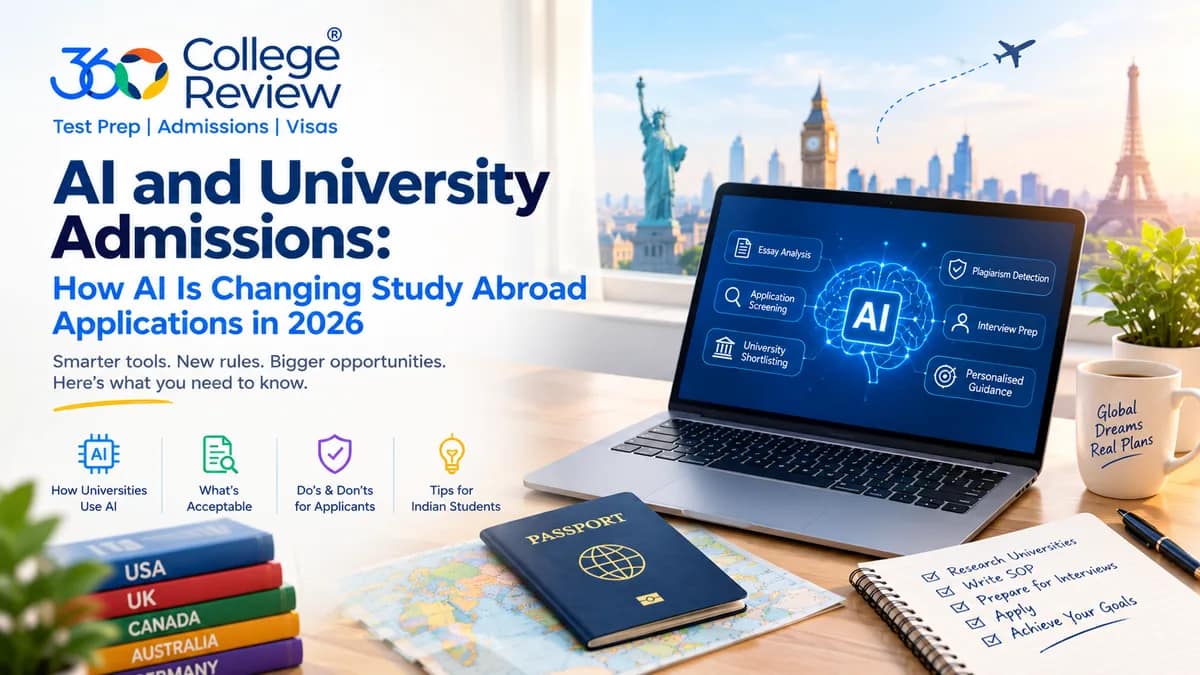
If you’re applying to universities abroad in 2026, you’re stepping into an admissions landscape that didn’t exist three years ago. AI is now on both sides of the desk — universities use it to screen applications, and students use it to write essays, shortlist universities, and prep for interviews. The result is an “AI arms race” that’s reshaping how admissions work globally.
Love it or fear it, AI in admissions is here to stay. The question isn’t whether to use AI — it’s how to use it ethically, strategically, and in a way that actually strengthens your application rather than flagging it.
Let’s break down what’s happening, what’s acceptable, and how to navigate this new landscape as an Indian student applying abroad.
Many universities globally — particularly in the US, UK, and Australia — now use AI-powered tools to process large volumes of applications. These systems:
What this means for you: Your application may be partially or fully screened by AI before a human ever sees it. This means your application needs to be machine-readable — clear formatting, complete fields, no ambiguous language.
Universities are deploying sophisticated AI content detection tools to identify essays written by ChatGPT, Claude, Gemini, and other large language models. These tools analyze:
Important caveat: AI detection tools are not 100% accurate. False positives happen — genuinely original essays can be flagged as AI-generated. This is why most universities use AI detection as a signal for human review, not an automatic rejection.
The AI-in-education landscape evolved rapidly after ChatGPT’s November 2022 release:
Universities are themselves adopting AI tools — for teaching, student support, and administrative tasks. The message is nuanced: AI is welcomed in some contexts, banned in others.
University shortlisting: AI tools can help you identify universities that match your academic profile, budget, and career goals. Tools like CollegeVine, PrepScholar, and university finder tools use AI to recommend matches.
Scholarship matching: AI-powered platforms like Going Merry, Scholarships.com, and Fastweb match you with relevant scholarships based on your profile.
Interview preparation: AI tools can simulate admissions interviews, ask likely questions, and provide feedback on your responses. This is excellent practice — and no university objects to it.
Language and grammar checking: Grammarly, Quillbot, and similar tools help you write more clearly. Most universities accept grammar and spell-checking — they object to content generation, not language refinement.
Research assistance: AI can help you research universities, programs, faculty, and career outcomes faster. Understanding your target universities deeply is a sign of a strong applicant.
Test preparation: AI-powered prep tools for IELTS, TOEFL, PTE, GRE, GMAT, and SAT provide personalized practice, identify weaknesses, and adapt to your learning pace.
Brainstorming essay topics: Using AI to generate ideas, outlines, or structural suggestions for your SOP/essays. Some universities accept this (it’s like brainstorming with a mentor); others consider it AI assistance that must be disclosed.
Feedback on drafts: Getting AI to review your draft and suggest improvements. Similar to asking a teacher or counselor for feedback — but universities differ on whether AI feedback crosses a line.
Translation assistance: Using AI to translate essays from your native language to English. Accepted if the content is originally yours; questionable if AI is generating content, not just translating.
Full essay generation: Asking AI to write your entire SOP or personal statement. This is easily detected, widely prohibited, and can result in immediate rejection or admission revocation.
Fabricating achievements: Using AI to generate fake extracurriculars, awards, or research experience. This is fraud — and universities verify claims.
AI-generated recommendation letters: Having AI write your recommendation letters and having your referees sign them. Universities increasingly ask referees to write directly or use verified platforms.
Plagiarism of sample essays: Copying or lightly editing essays found online — AI detection tools catch this easily.
AI-Permissive Universities:
Some universities explicitly welcome AI tools in the application process — particularly for brainstorming, research, and language refinement. They may ask you to disclose AI use but don’t prohibit it.
AI-Restricted Universities:
Most universities prohibit AI-generated content in essays and personal statements. They use AI detection tools to screen submissions. If detected, you may face:
AI-Silent Universities:
Many universities haven’t published explicit AI policies. In the absence of a policy, assume the default: AI-generated content is not acceptable for essays, personal statements, or other original application components.
The best defense against AI detection — and the best way to stand out in an AI-saturated applicant pool — is to write an SOP that’s genuinely human. Here’s how:
AI can generate generic career aspirations. It cannot generate your specific memories, challenges, or “aha” moments. Use real anecdotes:
These specifics are AI-resistant — they’re unique to you.
Don’t say “I’m passionate about computer science.” Describe the project you built, the problem you solved, the 2am debugging sessions. AI tends to tell; humans show.
AI writes in polished, predictable patterns. Your writing should sound like you — which means some sentences might be longer, some shorter, some more informal. Don’t let anyone (including AI) “smooth out” your voice.
AI can generate a generic “Why this university” paragraph. It can’t connect your specific life experiences to specific faculty, courses, or research at the university. Do this manually — it’s the most AI-resistant part of your application.
Ask a teacher, counselor, or mentor to review your essay. Human feedback catches what AI misses: tone, authenticity, emotional resonance. AI feedback can help with grammar and structure — but it can’t tell you if your essay “sounds like you.”
AI is also reshaping standardized tests:
The trend: Standardized tests aren’t going away, but they’re being redesigned to be AI-resistant. The emphasis is shifting from multiple-choice to demonstrated skills and authentic assessments.
Here are ethical AI tools that can genuinely improve your study abroad applications:
For university shortlisting:
For test preparation:
For essay refinement (not generation):
For interview prep:
AI is changing university admissions — but it’s not making human judgment obsolete. If anything, AI makes authentic human stories more valuable, not less. When every applicant can generate a polished essay with ChatGPT, the applicant who writes something genuinely personal — with specific memories, real vulnerabilities, and unique insights — stands out more than ever.
Use AI ethically for research, test prep, grammar refinement, and interview practice. Don’t use it to generate your essays, fabricate experiences, or fake recommendations. The risk is real — AI detection is improving, and the consequences of getting caught are severe.
The smartest students in 2026 use AI as a tool, not a crutch. They use it to research faster, prepare smarter, and refine their communication. But the core of their application — their story, their achievements, their aspirations — is authentically theirs.
In an AI-saturated world, authenticity is your competitive advantage. Don’t outsource it.
– The Author is Mr. Ajay Thiara, Founder & Managing Director of 360 College Review